Inspired by the movie "The Corporation" and Everlast's "The Police Department is Like a Crew" on Prince Paul's "A Prince of Thieves" album.
Dirty language warning - but it's completely ironic!
Saturday, November 11, 2006

Friday, November 10, 2006
My Life With 60 Minutes

As long as I can remember 60 Minutes has been part of my life. When I was young, I was convinced that the show was called 60 Seconds. I found it, as my son would say - boring, and kept thinking, "Well, if it's only sixty seconds, it MUST be over soon." As an adult, I came to love 60 Minutes and look forward toward its place on my Sundays. My family has always suffered from what my mother calls "Sunday Blues." When I started teaching high school, these Sunday Blues became much more pronounced and 60 Minutes was there. 60 Minutes was the first show we were able to watch after September 11th. I love Mike Wallace, Ed Bradley, and particularly Morley Safer. Now Bradley has passed away. Wallace retired. I am stuck with Couric, who strikes me as fluffy, and Stahl who I think is a closet Republican. But, I'll keep watching, just the same.
Bedside Table: Stephen Vincent
Fires - the Robin Blazer essays from UC Press/
The Wedding Dress - Fanny Howe's essays, also from UC
7 Greek Poets - Translated by Guy Davenport, New Directions
For the Good of Liars, poems by Peter Manson (UK/Scots poet)
(Robin Blaser is so popular now!)
The Wedding Dress - Fanny Howe's essays, also from UC
7 Greek Poets - Translated by Guy Davenport, New Directions
For the Good of Liars, poems by Peter Manson (UK/Scots poet)
(Robin Blaser is so popular now!)
Bedside Table: Charles Alexander
Robin Blaser, THE FIRE (collected essays)
Robin Blaser, THE HOLY FOREST (collected poems)
both these are new from U-California Press
Cao Xueqin, THE STORY OF THE STONE
long-term reading project: 5 vols total, about to finish vol. 1
Alice Notley, DISOBEDIENCE
Virginia Woolf, TO THE LIGHTHOUSE
H.D., TRILOGY
does it count, since I am teaching those last two?
Gertrude Stein, GEOGRAPHY & PLAYS
Herman Melville, THE CONFIDENCE MAN
last two with a local reading group that meets a couple of times a month
Robin Blaser, THE HOLY FOREST (collected poems)
both these are new from U-California Press
Cao Xueqin, THE STORY OF THE STONE
long-term reading project: 5 vols total, about to finish vol. 1
Alice Notley, DISOBEDIENCE
Virginia Woolf, TO THE LIGHTHOUSE
H.D., TRILOGY
does it count, since I am teaching those last two?
Gertrude Stein, GEOGRAPHY & PLAYS
Herman Melville, THE CONFIDENCE MAN
last two with a local reading group that meets a couple of times a month
A Love Letter to Jeff, Thomas, JC, Tara, Mom, Dad, Marie S., John S., Rachel, Julia, Deanna and others.
I can't even begin to tell how important friendship is to me.
Fortunately, Stephanie Coontz can.
In a NY Times editorial earlier this week (Too Close For Comfort) she wrotes about the risks of modern marriage.
Coontz pointed out,
"St. Paul complained that married men were more concerned with pleasing their wives than pleasing God. In John Adams’s view, a “passion for the public good” was “superior to all private passions.” In both England and America, moralists bewailed “excessive” married love, which encouraged “men and women to be always taken up with each other.”
From medieval days until the early 19th century, diaries and letters more often used the word love to refer to neighbors, cousins and fellow church members than to spouses. When honeymoons first gained favor in the 19th century, couples often took along relatives or friends for company. Victorian novels and diaries were as passionate about brother-sister relationships and same-sex friendships as about marital ties.
The Victorian refusal to acknowledge strong sexual desires among respectable men and women gave people a wider outlet for intense emotions, including physical touch, than we see today. Men wrote matter-of-factly about retiring to bed with a male roommate, “and in each other’s arms did friendship sink peacefully to sleep.” Upright Victorian matrons thought nothing of kicking their husbands out of bed when a female friend came to visit. They spent the night kissing, hugging and pouring out their innermost thoughts."
Then,
"The insistence that marriage and parenthood could satisfy all an individual’s needs reached a peak in the cult of “togetherness” among middle-class suburban Americans in the 1950s. Women were told that marriage and motherhood offered them complete fulfillment. Men were encouraged to let their wives take care of their social lives."
And,
"Instead, we should raise our expectations for, and commitment to, other relationships, especially since so many people now live so much of their lives outside marriage. Paradoxically, we can strengthen our marriages the most by not expecting them to be our sole refuge from the pressures of the modern work force. Instead we need to restructure both work and social life so we can reach out and build ties with others, including people who are single or divorced. That indeed would be a return to marital tradition — not the 1950s model, but the pre-20th-century model that has a much more enduring pedi- gree."
Does my agreement with these statements point to the fact that I am a bad wife, and a dismissive mother. Hardly. I can barely let my husband go out to a movie at night because the entire time I am curled in a ball praying for his safe return. I do know that putting all one's eggs in one basket works for some. Not for me. I was once in a relationship were I was so taken by the person that I lessened or severed other relationships. Untimately, it was bad for me and bad for the relationship. I'm just glad those same friends were there when I came out of my stupor - perhaps they shouldn't have been.
This same boyfriend also told me that a good relationship is not two people looking at each other, but out into the world. Well, that wasn't exactly right either. Lovers have to look at each other SOMETIMES. I would agree that spouses and children come first, but friends should be a very close second.
P.S. I got flowers today from one such friend. He sent them all the way from Africa.
Fortunately, Stephanie Coontz can.
In a NY Times editorial earlier this week (Too Close For Comfort) she wrotes about the risks of modern marriage.
Coontz pointed out,
"St. Paul complained that married men were more concerned with pleasing their wives than pleasing God. In John Adams’s view, a “passion for the public good” was “superior to all private passions.” In both England and America, moralists bewailed “excessive” married love, which encouraged “men and women to be always taken up with each other.”
From medieval days until the early 19th century, diaries and letters more often used the word love to refer to neighbors, cousins and fellow church members than to spouses. When honeymoons first gained favor in the 19th century, couples often took along relatives or friends for company. Victorian novels and diaries were as passionate about brother-sister relationships and same-sex friendships as about marital ties.
The Victorian refusal to acknowledge strong sexual desires among respectable men and women gave people a wider outlet for intense emotions, including physical touch, than we see today. Men wrote matter-of-factly about retiring to bed with a male roommate, “and in each other’s arms did friendship sink peacefully to sleep.” Upright Victorian matrons thought nothing of kicking their husbands out of bed when a female friend came to visit. They spent the night kissing, hugging and pouring out their innermost thoughts."
Then,
"The insistence that marriage and parenthood could satisfy all an individual’s needs reached a peak in the cult of “togetherness” among middle-class suburban Americans in the 1950s. Women were told that marriage and motherhood offered them complete fulfillment. Men were encouraged to let their wives take care of their social lives."
And,
"Instead, we should raise our expectations for, and commitment to, other relationships, especially since so many people now live so much of their lives outside marriage. Paradoxically, we can strengthen our marriages the most by not expecting them to be our sole refuge from the pressures of the modern work force. Instead we need to restructure both work and social life so we can reach out and build ties with others, including people who are single or divorced. That indeed would be a return to marital tradition — not the 1950s model, but the pre-20th-century model that has a much more enduring pedi- gree."
Does my agreement with these statements point to the fact that I am a bad wife, and a dismissive mother. Hardly. I can barely let my husband go out to a movie at night because the entire time I am curled in a ball praying for his safe return. I do know that putting all one's eggs in one basket works for some. Not for me. I was once in a relationship were I was so taken by the person that I lessened or severed other relationships. Untimately, it was bad for me and bad for the relationship. I'm just glad those same friends were there when I came out of my stupor - perhaps they shouldn't have been.
This same boyfriend also told me that a good relationship is not two people looking at each other, but out into the world. Well, that wasn't exactly right either. Lovers have to look at each other SOMETIMES. I would agree that spouses and children come first, but friends should be a very close second.
P.S. I got flowers today from one such friend. He sent them all the way from Africa.
The Retarded
The New York Times has done it again!
In today's art section, Manohla Dargis refers to people with developmental disabilites, people with mental retardation - or (at minimum) retarded people - as THE RETARDED in her review of Shainberg's new film about Dianns Arbus. Dargis, who from here on will be referred to as the white girl, gives the film a pretty fair review. The white girl and I agree - why is Nicole Kidman in this role? I find it beyond ludicrous when actresses such as Paltrow (as Plath) and Kidman (as Arbus) portray our artistic heros. As the white girl points out: "Ms. Kidman bears no physical development resemblance to Arbus, who was small and dark and seemed very much tethered to the earth." To my small mind, which unrightly worships artists, it is a scandel to make a film such a film about Arbus. The white girl seems to hint that Shainberg means to show Arbus' sexual awakening. Who cares? How about the fact that Arbus was a damn good photographer.
In today's art section, Manohla Dargis refers to people with developmental disabilites, people with mental retardation - or (at minimum) retarded people - as THE RETARDED in her review of Shainberg's new film about Dianns Arbus. Dargis, who from here on will be referred to as the white girl, gives the film a pretty fair review. The white girl and I agree - why is Nicole Kidman in this role? I find it beyond ludicrous when actresses such as Paltrow (as Plath) and Kidman (as Arbus) portray our artistic heros. As the white girl points out: "Ms. Kidman bears no physical development resemblance to Arbus, who was small and dark and seemed very much tethered to the earth." To my small mind, which unrightly worships artists, it is a scandel to make a film such a film about Arbus. The white girl seems to hint that Shainberg means to show Arbus' sexual awakening. Who cares? How about the fact that Arbus was a damn good photographer.
Bedside Table: Larissa Shmailo
Ahkmatova, Selected. Better in Russian, in a beautiful small but thick white book--a gift from the fine poet and "Feminist Who Changed the World" Susan Maurer
Larissa Shmailo
Larissa Shmailo
Happy 37th to Jen and Tomas!
Tommorrow is my 37th birthday. We will be @ the Mark Bar after 6 - everyone is welcome.
A pacifist born on Vet's Day! How's that for flarf?
A pacifist born on Vet's Day! How's that for flarf?
More Enough
Juan Williams and Bill Cosby also complain of people who cannot speak “proper English. My first thought is to agree with them. It is annoying and strange when I hear African-Americans in very high positions of power (my ex-boss in particular) drop their s’s and conjegate their verbs incorrectly. I just wonder how this has become so intregrated into the culture that people who have Master's degrees have to consciously remind themselves to speak Standard English. The only reason I can come up with is to disagree with Williams and argue that slavery did have an impossibly lasting effect. It irreprably (Sp?) altered the English language.
What I always tell my students is that there is a time and place for most things (except George Bush). Street talk belongs with friends, standard English belongs in the school and work place. I try not to qualify it. I tell them that one is no better than the other, they just have different functions. But, am I right. As I said before, in accademia, many people with high positions do not speak SAE, so it's difficult to convince kids that it's necessary.
As a final note:
What confuses me is that a race, it seems that a race that has suffered such horrible prejudice would be more high sympathy toward other minority groups. Not so. Again, I can only speak from my own experience with inner-city teens. They hate Arabs (which they insist on calling A(long a) –rabs. They hate Jews (who they argue are dirty). They think guys are utterly disguisting (although they created the “down-low.”) And aren’t particularly admenable to people with disabilities either. Ironically, the group they show the lest hate toward (again, in my small experience) are WHITES!
What I always tell my students is that there is a time and place for most things (except George Bush). Street talk belongs with friends, standard English belongs in the school and work place. I try not to qualify it. I tell them that one is no better than the other, they just have different functions. But, am I right. As I said before, in accademia, many people with high positions do not speak SAE, so it's difficult to convince kids that it's necessary.
As a final note:
What confuses me is that a race, it seems that a race that has suffered such horrible prejudice would be more high sympathy toward other minority groups. Not so. Again, I can only speak from my own experience with inner-city teens. They hate Arabs (which they insist on calling A(long a) –rabs. They hate Jews (who they argue are dirty). They think guys are utterly disguisting (although they created the “down-low.”) And aren’t particularly admenable to people with disabilities either. Ironically, the group they show the lest hate toward (again, in my small experience) are WHITES!
Thursday, November 09, 2006
More From Juan William's Enough
Juan Williams' new book Enough (written in reaction to the Cosby contraversy) covers various topics that he finds problematic in African-American culture today: inappropriate rap music, weak and/or corrupt leaders, putting consumerism above education, and the push for reparations for slavery.
For example, Williams calls the reparations movement "a flashy distraction from the real work black America needs to do to take advantage of a nation that has more opportunities for black people than ever." He argues that reparations are not appropriate in the way that they were for Japanese-American in US internment camps or Jewish people in Germany. Partially, his argument lies in the fact that all of the slaves (and their owners) have been dead for many gnerations. Also, reparations will keep African-Americans in a victim role.
Unlike Williams I am not entirely against reparations. Slavery is often underexplained. It was not a mere economic problem. I largely thought this until I read Fredrick Douglass. Slaves were not only removed from their countries unwillingly, but they were put on boats and forced to live without food or water for many days. Many people died, and those that survived lived in the worst conditions humanly possible. Once in the United States, families were separtated, women were constantly raped, and men brutally beaten. Small children were taken from their mothers. Slaveholders would ply their slaves with alcohol on Sunday to make fun and sport of their drunken stupidity. People who spoke the same language were removed from each other- thus, the development of a pidgeon, which has sense moved into Eubonics.
I think that poor people are bound by a new form of slavery in the United States: consumerism and materialism. Inner-city people are by no means the only group drawn into this system, but there is a seems as obsession with “things” that is particularly ironic and detrimental. People continue to live in the projects, and some argue that this is by choice. I have been told that rent in many "projects" exceeds $1000. This is still a cake-walk by New York standards. If people chose to live there, I think there is some gross mismanangement going. Why would people “chose” to live in areas in which drugs, rats, gunshot, pee-filled hallways, and non-working elevators are common. But, what I have not been able to understand is why people living under these conditions have numerous $100 pairs of tennis shoes, ipods, cell phones, and Gucci bags. I cannot tell you how many inner-city kids I taught in five years who had and have better electronics, shoes, clothes, and jewelry than me (I wear chuck T’s, no jewelry, have only had a cell for a year (which ONLY – believe it or not – CALLS people). I own no musical electronics and we have two computers (our family desk top and a lap-top that my husband’s job gave him). I’ll tell you what we do have – a condo in a nice neighborhood with friendly, good neighbors. We do have the occasional roach, but no rats, guns, or drug-dealers in sight. I don’t mean to brag. I know how lucky I am. However, I could CHOSE to live in Carnasie, and afford that $400 cell phone.
I have had students tell me that they will willingly steal cars (to have the car) or deal (to have the money). When I ask them if their freedom isn’t more important than a car, they shrug it off. Most, truly do not believe they can get caught. Others believe it is worth the risk. Williams blames hip-hop and rap largely for the disintergration of African-American values. Hmmmm….I’m still thinking about this…..But I do agree that modern day rap and it’s obsession with “bling” perpetuates this utterly ridiculous desire for “stuff.”
What worries me about reparations is where will the money go. It seems it would go to perpetuate this new slavery. The slavery of putting stuff before happiness.
For example, Williams calls the reparations movement "a flashy distraction from the real work black America needs to do to take advantage of a nation that has more opportunities for black people than ever." He argues that reparations are not appropriate in the way that they were for Japanese-American in US internment camps or Jewish people in Germany. Partially, his argument lies in the fact that all of the slaves (and their owners) have been dead for many gnerations. Also, reparations will keep African-Americans in a victim role.
Unlike Williams I am not entirely against reparations. Slavery is often underexplained. It was not a mere economic problem. I largely thought this until I read Fredrick Douglass. Slaves were not only removed from their countries unwillingly, but they were put on boats and forced to live without food or water for many days. Many people died, and those that survived lived in the worst conditions humanly possible. Once in the United States, families were separtated, women were constantly raped, and men brutally beaten. Small children were taken from their mothers. Slaveholders would ply their slaves with alcohol on Sunday to make fun and sport of their drunken stupidity. People who spoke the same language were removed from each other- thus, the development of a pidgeon, which has sense moved into Eubonics.
I think that poor people are bound by a new form of slavery in the United States: consumerism and materialism. Inner-city people are by no means the only group drawn into this system, but there is a seems as obsession with “things” that is particularly ironic and detrimental. People continue to live in the projects, and some argue that this is by choice. I have been told that rent in many "projects" exceeds $1000. This is still a cake-walk by New York standards. If people chose to live there, I think there is some gross mismanangement going. Why would people “chose” to live in areas in which drugs, rats, gunshot, pee-filled hallways, and non-working elevators are common. But, what I have not been able to understand is why people living under these conditions have numerous $100 pairs of tennis shoes, ipods, cell phones, and Gucci bags. I cannot tell you how many inner-city kids I taught in five years who had and have better electronics, shoes, clothes, and jewelry than me (I wear chuck T’s, no jewelry, have only had a cell for a year (which ONLY – believe it or not – CALLS people). I own no musical electronics and we have two computers (our family desk top and a lap-top that my husband’s job gave him). I’ll tell you what we do have – a condo in a nice neighborhood with friendly, good neighbors. We do have the occasional roach, but no rats, guns, or drug-dealers in sight. I don’t mean to brag. I know how lucky I am. However, I could CHOSE to live in Carnasie, and afford that $400 cell phone.
I have had students tell me that they will willingly steal cars (to have the car) or deal (to have the money). When I ask them if their freedom isn’t more important than a car, they shrug it off. Most, truly do not believe they can get caught. Others believe it is worth the risk. Williams blames hip-hop and rap largely for the disintergration of African-American values. Hmmmm….I’m still thinking about this…..But I do agree that modern day rap and it’s obsession with “bling” perpetuates this utterly ridiculous desire for “stuff.”
What worries me about reparations is where will the money go. It seems it would go to perpetuate this new slavery. The slavery of putting stuff before happiness.
Wednesday, November 08, 2006

A New Low in Motherhood

Last night I was reading Tama Janowitz's Area Code 212, a collection of her essays on motherhood, New York, art, and (for some strange reason) animals. The book is dedicated to Paige Powell, my guy Basquiat's primary girlfriend.
I have always liked Janowitz more in theroy than in practice. I think her writing (as text) is fluffy and not that well-written. (Maybe I'm too critical though...as Ellison's Invisible Man was in my other hand. Gosh! I AM my father on EVERY level.) My feeling for Janowitz is kind of like my feeling for Hillary - I can't love her, but she's too pretty, smart, and charming to exactly hate. Slaves of New York was sort of our field guide to hipness in dorky ole' Albuquerque. Although, now that I am a New Yorker, I see the book should have been titled Slaves TO New York.
In any case, last night I was reading Tama's short essays on motherhood -which were really great. At one point she writes, "It occurred to me that I wasn't quite cut out for motherhood." This is the narrative of my existance.
Today, for the 56th time, in the 60 days of school that have occurred, my son refused to put his socks on. I had a total breakdown. I told him that I hated him and I was moving out. I told him that he was an f....brat and that I couldn't take it anymore. I feel horrible...even as I write this. But, I don't know what else to do, but write about it. We made up. He won - for today. No socks. Why is does parenting make kung fu or the army look like a cocktail party? How do our tiny ones make us show our impossibly best and our impossibly worst sides.
Ms. Janowitz writes, "Well, I made it though the day, and I only have another forty or fifty years to go."
Tuesday, November 07, 2006
Just When You Thought Humanity Could Not Go Any Lower
From an email today:
"An amendment to the Idaho Constitution to read "A marriage between a man and a woman is the only domestic legal union that shall be valid or recognized in this state," thus going well beyond the usual homophobic attempts at legislation.
An initiative to reverse a Boise City Council decision to remove a monument of the Ten Commandments from a city park. (The monument was removed when it was cited as a rationale for Kansas minister Fred Phelps ( http://www.godhatesfags.com) and his organization's putting up a monument celebrating the murder of Matthew Sheppard.)
Now, on election day, I'm going to check in with my best pals at Media Needle (and so should you!)
"An amendment to the Idaho Constitution to read "A marriage between a man and a woman is the only domestic legal union that shall be valid or recognized in this state," thus going well beyond the usual homophobic attempts at legislation.
An initiative to reverse a Boise City Council decision to remove a monument of the Ten Commandments from a city park. (The monument was removed when it was cited as a rationale for Kansas minister Fred Phelps ( http://www.godhatesfags.com) and his organization's putting up a monument celebrating the murder of Matthew Sheppard.)
Now, on election day, I'm going to check in with my best pals at Media Needle (and so should you!)
Bedside Table: Julia Hecomovich
Grey Catsby's List is:
PILE 1
Daniel Kehlmann "Ich and Kaminski"
Christina Griebel "Wenn es regnet, dann regnest es immer gleich auf den
Kopf"
Stefan Heym "Fuenf tage im Juni"
NASB Study Bible
E.R. Carmin "Das schwarze Reich"
"Teach Yourself Latin"
Analytical Lexicon Greek New Testament
PILE 2
O'Collins "Interpreting the Resurrection"
Freyne "The World of the New Testament"
5 Notebooks
King James Greek Interlinear New Testament
Teach Yourself Arabic
IN BETWEEN PILE 1 & PILE 2
Spiegel "Wer regiert Deutschland?"
Tix to GNR concert Friday in Madison Sq Garden
PILE 1
Daniel Kehlmann "Ich and Kaminski"
Christina Griebel "Wenn es regnet, dann regnest es immer gleich auf den
Kopf"
Stefan Heym "Fuenf tage im Juni"
NASB Study Bible
E.R. Carmin "Das schwarze Reich"
"Teach Yourself Latin"
Analytical Lexicon Greek New Testament
PILE 2
O'Collins "Interpreting the Resurrection"
Freyne "The World of the New Testament"
5 Notebooks
King James Greek Interlinear New Testament
Teach Yourself Arabic
IN BETWEEN PILE 1 & PILE 2
Spiegel "Wer regiert Deutschland?"
Tix to GNR concert Friday in Madison Sq Garden
Bedside Table: Marcella Durand
Lamp
Glass of water
Burnt House to Paw Paw by Merrill Gilfillan
A Nomad Poetics by Pierre Joris
Reading the Illegible by Craig Dworkin
Ecopoetics no. 4/5
Poetry and the Fate of the Senses by Susan Stewart
A Tall, Serious Girl by George Stanley
Cape Cod Diary by Lydia Davis
A Geology by Clark Coolidge
Science and Steepleflower by Forrest Gander
stuffed in side of bed: Sierra magazine
Glass of water
Burnt House to Paw Paw by Merrill Gilfillan
A Nomad Poetics by Pierre Joris
Reading the Illegible by Craig Dworkin
Ecopoetics no. 4/5
Poetry and the Fate of the Senses by Susan Stewart
A Tall, Serious Girl by George Stanley
Cape Cod Diary by Lydia Davis
A Geology by Clark Coolidge
Science and Steepleflower by Forrest Gander
stuffed in side of bed: Sierra magazine
Cruise and Holmes Call it splits

Now that I have your attention! Please remember to go vote! I voted today with my two charges (Arielle and Jeffrey) as school is out today. I tried to explain the process to the best of my ability which was a complete failure! I can't explain voting - but I could write a poem about it. Here's how I voted today in Brooklyn:
1. Eliot Spitzer (a all-around great guy)
2. Hevesi (he paid state money to drive his sick wife around, but I LOVE his commericial. No one in my house can even figure out what a comptroller is, so I'm not sure it matters.)
3. Senator( Some guy from the Green Party named Howie. I have very mixed feelings about Hillary. I think she's a weak politiciam who talks the talk, but doesn't really follow through. At least poor Howie will get 2 votes - I'll make Jim vote for him too.)
4. A bunch of Demo's I've never heard of for posts I'm not sure I grasp. Hey! As long as they're demo's.
Monday, November 06, 2006
Sunday, November 05, 2006
Bedside Table: Siobhan Ciminera
Books:
Something Wicked This Way Comes, Ray Bradbury
The Best of American Poetry 2006
Long Day's Journey into Night, Eugene O'Neill
The Sonnets, Ted Berrigan
Schott's Almanac 2007, Ben Schott
Century: One Hundred Years of Human Progress, Regression, Suffering and
Hope, Bruce Bernard
Portraits, Steve McCurry
In the Night Room, Peter Straub
Other items:
Remote controls
Necklaces
Sleep mask
Pills
One random CD
Thanks so much!
Siobhan Ciminera
MFA Poetry student at The New School
Something Wicked This Way Comes, Ray Bradbury
The Best of American Poetry 2006
Long Day's Journey into Night, Eugene O'Neill
The Sonnets, Ted Berrigan
Schott's Almanac 2007, Ben Schott
Century: One Hundred Years of Human Progress, Regression, Suffering and
Hope, Bruce Bernard
Portraits, Steve McCurry
In the Night Room, Peter Straub
Other items:
Remote controls
Necklaces
Sleep mask
Pills
One random CD
Thanks so much!
Siobhan Ciminera
MFA Poetry student at The New School

Saturday, November 04, 2006
Bedside Table: Susan Briante
Glass of water, 1/4 full
Coaster stolen from a hotel room, Marfa, TX
Chewable Melatonin 3mg (90 tablets)
Naproxin Sodium 220 mg (50 capsules)
A photograph of my 3-year-old self with fabulous plastic sun glasses
and strange garden tool
This Connection of Everyone With Lungs, Juliana Spahr
A Day Book, Robert Creeley
Disobedience, Alice Notley
Don't Let Me Be Lonely, Claudia Rankine
The Teaching of Buddha, stolen from a hotel room, Dallas, TX
Susan Briante is tired of playing nice.
Coaster stolen from a hotel room, Marfa, TX
Chewable Melatonin 3mg (90 tablets)
Naproxin Sodium 220 mg (50 capsules)
A photograph of my 3-year-old self with fabulous plastic sun glasses
and strange garden tool
This Connection of Everyone With Lungs, Juliana Spahr
A Day Book, Robert Creeley
Disobedience, Alice Notley
Don't Let Me Be Lonely, Claudia Rankine
The Teaching of Buddha, stolen from a hotel room, Dallas, TX
Susan Briante is tired of playing nice.

Bedside Table: My Sweet Husband: Jim Stewart
dirt
a lego catalog for Winter 2006
an alarm clock
View From Weaving Mountain - Nathaniel Tarn (my book)
Humpty Dumpty An Oval - Damon Knight
Spaceships (Jeff's Book)
The Marginalization of Poetry - Bob Perelman (my book, but Jim's read it & I haven't)
a light with no bulb (Jim only sleeps and has sex in bed...I live here)
a lego catalog for Winter 2006
an alarm clock
View From Weaving Mountain - Nathaniel Tarn (my book)
Humpty Dumpty An Oval - Damon Knight
Spaceships (Jeff's Book)
The Marginalization of Poetry - Bob Perelman (my book, but Jim's read it & I haven't)
a light with no bulb (Jim only sleeps and has sex in bed...I live here)
Bedside Table: Mairead Byrne
li-lo
beach towel
beach umbrella
hamper
sandals
Mairead Byrne has a large bedside table.
beach towel
beach umbrella
hamper
sandals
Mairead Byrne has a large bedside table.
Bedside Table: Tisa Bryant
Stalagmite-of-books-cum-nightstand:
The Magazine Novels of Pauline Hopkins (reading it for the slavery-era
gothic, Hagar's Daughter, within)
The Coming Community, Giorgio Agamben
Centering Woman: Gender Discourses in Caribbean Slave Society, Hilary
McD Beckles (he's a man)
Incubation: A Space for Monsters, Bhanu Kapil
New York City Subway Map (I read this like the dictionary)
Let It Be Told: Black Women Writers in Britain
Stigmata, Helene Cixous
Lady in a Boat, Merle Collins (she's a woman)
Seismosis, John Keene & Christopher Stackhouse
Splay Anthem, Nathaniel Mackey
The Magazine Novels of Pauline Hopkins (reading it for the slavery-era
gothic, Hagar's Daughter, within)
The Coming Community, Giorgio Agamben
Centering Woman: Gender Discourses in Caribbean Slave Society, Hilary
McD Beckles (he's a man)
Incubation: A Space for Monsters, Bhanu Kapil
New York City Subway Map (I read this like the dictionary)
Let It Be Told: Black Women Writers in Britain
Stigmata, Helene Cixous
Lady in a Boat, Merle Collins (she's a woman)
Seismosis, John Keene & Christopher Stackhouse
Splay Anthem, Nathaniel Mackey
Friday, November 03, 2006
One Day, I Woke Up and I Was (kind of) Conservative
For about two weeks, I have been reading Juan Williams' book Enough (The Phony Leaders, Dead-End Movements, and Culture of Failure That Are Undermining Black America - and What We Can Do About It). I first heard of this book in the NY Times a number of months ago. I was immediately captivated. I didn't get the book until recently though when it came in at the library.
When I first began reading Williams arguements, which are a response to and an agreement with Bill Cosby's controversial speech at the anniversary of Brown V. The Board of Education, I was taken in quickly by everything he said. Then, I glanced at his bio. Williams (much to my horror) is a panelist on Fox News Sunday (i.e. a Republican). This made me read his agruments with a more leery eye. But, I still agree with much of what he says. Williams (and Cosby) argues that there is a sure-fire way, three step way to escape poverty. Stay in school, get a job (any job) and keep it, and do not have children until later in life.
I think though that "family values" have too long been hijacked by Conservatives. Hey, liberals have families too. I think that Republicans/conservatives have taken the ideas of "family values" and twisted in them into a life style that imprisons people. But, as I get older, I agree with some of the stuff that seemed wacky before.
1. Abortion should DEFINITELY be legal. The reasons for this are infanently, and, in my stupid mind, non-debatable. However, abortion should rarely, if ever, be used as birth control. There are many instances, too obvious to name here, were an abortion is appropriate or necessary. I'm sorry. Failure to use birth control because you are young, horny, irresponsibleness, out of money for condoms, lazy, or bored is just not one of them. Pro-choice (and pro-life) people both downplay the seriousness of abortion for women. Most women I know have had one. None of them are happy about it, and all of them were at least slightly traumatized by it. I was never that opinionated about abortion until I had my son. I don't care, something with a heartbeat at 7 months is a living thing. Unfortunately, people who oppose the morning after pill are REALLY on the wrong band wagon. To me, this pill is a God send. I would MUCH rather see someone abort one day after conception than 7 weeks, 10 weeks, six months. According to Catholic tradition, the being is a baby the minute sperm hits the egg, but this is philosophy, not science. A fetus of seven weeks has a heartbeat (I heard it!) so then practicality gets involved.
2. Teenagers should not have sex, PERIOD. This is not one of those life is complicated things...they just shouldn't do it. I taught teenagers for 5 years. They are just not mature enough to handle all the crap that goes with sex - and certainly not AIDS or parenthood. Someone on Silliman's blog said something about teenage sexual energy. I say masturbate! And put the rest of the energy into art, sports, or getting into Harvard (has anyone seen the Seifeld where George stops having sex and becomes a genius?)
3. Teenagers will have sex. So teach them to use birth control. My kids tell me, I can't talk to a guy about condoms. I tell them, if you can take off all your clothes and get in bed naked with them, you should be able to talk to them.
4. Single people can party all night. Married people can do what they want. But, if you decide to have a kid (or even if she's an accident) life should be oriented toward the family. People gripe about poor people not caring for their children, but I think it's worse sometimes in middle-class, upper-class families. The American system is so screwed up. Most people are slaves to consumerism. I hate it. Republicans tell us that we should be family oriented, and then that we should work, work, work, so we can shop, shop, shop. I'm sorry, I think money and family values are opposing forces. Both take time! A mother who lives in the South and has to be gone 12 hours a day to feed her kid is criticized and penalized. But, what about all the upper class New York mothers and fathers who work 70 hours a week (so they can be rich) and pay no attention to their kids. Why is this the norm? Why is this okay? I am certainly not saying mothers and fathers should not work. For a family to run, every unit must be happy, including the cats. The mother in particular (as we have been too long repressed) should work, no work, make art, or do whatever makes her happy. (Another conservative mistake, a mom FORCED to be a homemaker or do anything against her will is not a happy mom, is not a happy child). But, the mistake here is putting money and commerce above your family. Your family needs YOU not a classic six on Park Avenue.
This leads me to thinking about Williams point: Why DOES every in the Projects have really nice shoes? More tommorrow.
When I first began reading Williams arguements, which are a response to and an agreement with Bill Cosby's controversial speech at the anniversary of Brown V. The Board of Education, I was taken in quickly by everything he said. Then, I glanced at his bio. Williams (much to my horror) is a panelist on Fox News Sunday (i.e. a Republican). This made me read his agruments with a more leery eye. But, I still agree with much of what he says. Williams (and Cosby) argues that there is a sure-fire way, three step way to escape poverty. Stay in school, get a job (any job) and keep it, and do not have children until later in life.
I think though that "family values" have too long been hijacked by Conservatives. Hey, liberals have families too. I think that Republicans/conservatives have taken the ideas of "family values" and twisted in them into a life style that imprisons people. But, as I get older, I agree with some of the stuff that seemed wacky before.
1. Abortion should DEFINITELY be legal. The reasons for this are infanently, and, in my stupid mind, non-debatable. However, abortion should rarely, if ever, be used as birth control. There are many instances, too obvious to name here, were an abortion is appropriate or necessary. I'm sorry. Failure to use birth control because you are young, horny, irresponsibleness, out of money for condoms, lazy, or bored is just not one of them. Pro-choice (and pro-life) people both downplay the seriousness of abortion for women. Most women I know have had one. None of them are happy about it, and all of them were at least slightly traumatized by it. I was never that opinionated about abortion until I had my son. I don't care, something with a heartbeat at 7 months is a living thing. Unfortunately, people who oppose the morning after pill are REALLY on the wrong band wagon. To me, this pill is a God send. I would MUCH rather see someone abort one day after conception than 7 weeks, 10 weeks, six months. According to Catholic tradition, the being is a baby the minute sperm hits the egg, but this is philosophy, not science. A fetus of seven weeks has a heartbeat (I heard it!) so then practicality gets involved.
2. Teenagers should not have sex, PERIOD. This is not one of those life is complicated things...they just shouldn't do it. I taught teenagers for 5 years. They are just not mature enough to handle all the crap that goes with sex - and certainly not AIDS or parenthood. Someone on Silliman's blog said something about teenage sexual energy. I say masturbate! And put the rest of the energy into art, sports, or getting into Harvard (has anyone seen the Seifeld where George stops having sex and becomes a genius?)
3. Teenagers will have sex. So teach them to use birth control. My kids tell me, I can't talk to a guy about condoms. I tell them, if you can take off all your clothes and get in bed naked with them, you should be able to talk to them.
4. Single people can party all night. Married people can do what they want. But, if you decide to have a kid (or even if she's an accident) life should be oriented toward the family. People gripe about poor people not caring for their children, but I think it's worse sometimes in middle-class, upper-class families. The American system is so screwed up. Most people are slaves to consumerism. I hate it. Republicans tell us that we should be family oriented, and then that we should work, work, work, so we can shop, shop, shop. I'm sorry, I think money and family values are opposing forces. Both take time! A mother who lives in the South and has to be gone 12 hours a day to feed her kid is criticized and penalized. But, what about all the upper class New York mothers and fathers who work 70 hours a week (so they can be rich) and pay no attention to their kids. Why is this the norm? Why is this okay? I am certainly not saying mothers and fathers should not work. For a family to run, every unit must be happy, including the cats. The mother in particular (as we have been too long repressed) should work, no work, make art, or do whatever makes her happy. (Another conservative mistake, a mom FORCED to be a homemaker or do anything against her will is not a happy mom, is not a happy child). But, the mistake here is putting money and commerce above your family. Your family needs YOU not a classic six on Park Avenue.
This leads me to thinking about Williams point: Why DOES every in the Projects have really nice shoes? More tommorrow.

Thursday, November 02, 2006
Bedside Table: Meghan Punschke
At any rate, I have a lot of junk on my two-tier nightstand: A lamp, a CD Clock Radio, a mound of sticky notes espousing random thoughts, a red leather cup that holds pencils, pens, highlighters and two remotes (one for the TV one for the DVD/VCR). I have also precariously proped a hand painted picture frame between the lamp and the wall. (The frame does not hold a picture, but rather a paper splashed with golden paint swirls). On the bottom shelf, there is a stack of publications I have yet to read, but intend to. Among them, new issues of "The New Yorker," "Poets and Writers" and Amy King's new chapbook.
Bedside Table: Anne Tardos
Marcel Proust: Swann's Way. Lydia Davis translation.
Henry James: What Maisie Knew
Jean Cocteau: Le Grand Ecart
Michio Kaku: Hyperspace
Conjunctions 45: Secret Lives of Children
Anne Tardos: The Dik-dik's Solitude
Patricia Stein: The Chakra, Mantra Cookbook
Aeschylus: Four Tragedies
Bernadette Mayer: Sonnets
The objects:
Radio/Alarm clock.
A sound machine (making natural sounds) to help me fall asleep, and which I never use.
Dozens of pens and color pencils, a sharpener, and an eraser.
A drawing/writing pad.
Some bookmarks.
Henry James: What Maisie Knew
Jean Cocteau: Le Grand Ecart
Michio Kaku: Hyperspace
Conjunctions 45: Secret Lives of Children
Anne Tardos: The Dik-dik's Solitude
Patricia Stein: The Chakra, Mantra Cookbook
Aeschylus: Four Tragedies
Bernadette Mayer: Sonnets
The objects:
Radio/Alarm clock.
A sound machine (making natural sounds) to help me fall asleep, and which I never use.
Dozens of pens and color pencils, a sharpener, and an eraser.
A drawing/writing pad.
Some bookmarks.
Be My Guest!
I am looking for guest bloggers to write short essays. I'm most interested in poetry, disability, book reviews, reports from readings, visual arts, and reports of philothopy. If interested please send query with bio to www.saintlizstreet@hotmail.com
Mommy, Don't Dawdle
Yesterday, the inevitable happened. My son realized that I was handicapped.
We were walking to kung fu classed when he started telling me, "Mommy, you're dawdling." I thought this was hilarious and had no idea what he was talking about, which is often the case.
While Jeff's dad was reading to him before bed, I came in to reaccount the story. Jeff remembered that he had said this. He showed his dad the way I walk...it was actually frightenly accurate. Then, Jeff gave me some hints on how to walk the "right way." He told me that I just had to practice.
This morning he asked me if I had been practicing.
Needless to say, this has put me in a mood. (Not to mention the fact that I can't go ice skating because it's raining today.) But, I think I shouldn't take it so hard. I think there is that moment in life (or many of them) when children see that their parents are not perfect. They wake up one day and say "my parents are poor, or can't spell, or are selfish, or, well, can't walk straight."
Then, they might say, as Jeff did: "If anyone is mean to my mom, I'll ignore them. I won't be their friend." Or, if he's really pissed, "I'll make them smoke a cigarette."
We were walking to kung fu classed when he started telling me, "Mommy, you're dawdling." I thought this was hilarious and had no idea what he was talking about, which is often the case.
While Jeff's dad was reading to him before bed, I came in to reaccount the story. Jeff remembered that he had said this. He showed his dad the way I walk...it was actually frightenly accurate. Then, Jeff gave me some hints on how to walk the "right way." He told me that I just had to practice.
This morning he asked me if I had been practicing.
Needless to say, this has put me in a mood. (Not to mention the fact that I can't go ice skating because it's raining today.) But, I think I shouldn't take it so hard. I think there is that moment in life (or many of them) when children see that their parents are not perfect. They wake up one day and say "my parents are poor, or can't spell, or are selfish, or, well, can't walk straight."
Then, they might say, as Jeff did: "If anyone is mean to my mom, I'll ignore them. I won't be their friend." Or, if he's really pissed, "I'll make them smoke a cigarette."
Greetings from Maputo! Caitilin Shannon
(Caitilin Shannon is a good friend who has just completed law school. She was hired this summer by Doctors Without Borders to do an internship in Africa.)
I have arrived safely, well, and for the first time in a long time, well rested, if you can believe it. I was tempted to flee the apartment last night, as there was music pumping all night long from some club nearby, that and the night was gorgeous, breezy cool but not cold. The view of the city from my apartment is quite stunning – but then I guess that is what happens when you live 14 or so floors above the ground. Sigh. The primary disadvantage of high living is the fact that the elevators here are unpredictable at best. Last night was my introduction to walking 15 flights of stairs – makes the NYC walk-up seem like a warm-up.
So I have not been to the any of the clinics yet, but have had a chance to meet much of the teams. We had a planning meeting yesterday, to discuss goals for 2007. It was a great way to be introduced to the work and to see the various personalities of the two teams – Maputo and Lichinga. The work here is finally real, and from my briefing in Geneva and various discussion here so far, it seems that I will be plenty busy over the next months, which makes me happy. However, the work will be much easier once my Portuguese is more functional. The learning curve is steep though, and so far I have not fallen off. Thanks to my Spanish, I think that it won’t be so bad picking up the language.
As for my living situation – I am in an apartment which is HUGE and which I share with one other person, Natia. The street is called Avenida de Mao Tse Tung, not far from Marx and Lenin Boulevards. From the 14th floor there are views of the city from all sides, and I can see the ocean from my bedroom window, which is such a luxury. It is still a bit far to the water, but the view itself is nevertheless a form of catharsis. Natia is lovely: she is from Georgia and has about 5 years or so experience in administering MSF (Doctor's without Borders) projects. She has lots of stories to tell and is quite down to earth.
Natia has been giving me a tour of Maputo over the past two or so days. The city is nice… like many cities I have visited before – San Salvador, Mexico City, Tirana, Bombay – but then quite different. The climate is sort of Mediterranean – varied temperatures, with hot summers and mild winters, and somewhat dry. Ocean breezes abound. There are bougainvillea everywhere, as well as frangiapani, jacaranda, and flamboyan trees. Streets are wide and fairly clean, though many are quite in disrepair, not so unlike my hometown, NYC. Friday night I got a taste of the nightlife here – a bunch of us went to see a band, great music. Strangely in many ways being out was quite like being out in NYC (the NYC I like), in the vibe of the bars and music and the people, though not in the number of options.
The good news about communication in Maputo is that it’s pretty good. The office, where I will work some of the time, has 24-7 internet access, at home I have a landline, and I hope to get a cellular sometime this week or next weekend.
Well, that is all for now, more soon, especially reflections from my first week atwork.
I have arrived safely, well, and for the first time in a long time, well rested, if you can believe it. I was tempted to flee the apartment last night, as there was music pumping all night long from some club nearby, that and the night was gorgeous, breezy cool but not cold. The view of the city from my apartment is quite stunning – but then I guess that is what happens when you live 14 or so floors above the ground. Sigh. The primary disadvantage of high living is the fact that the elevators here are unpredictable at best. Last night was my introduction to walking 15 flights of stairs – makes the NYC walk-up seem like a warm-up.
So I have not been to the any of the clinics yet, but have had a chance to meet much of the teams. We had a planning meeting yesterday, to discuss goals for 2007. It was a great way to be introduced to the work and to see the various personalities of the two teams – Maputo and Lichinga. The work here is finally real, and from my briefing in Geneva and various discussion here so far, it seems that I will be plenty busy over the next months, which makes me happy. However, the work will be much easier once my Portuguese is more functional. The learning curve is steep though, and so far I have not fallen off. Thanks to my Spanish, I think that it won’t be so bad picking up the language.
As for my living situation – I am in an apartment which is HUGE and which I share with one other person, Natia. The street is called Avenida de Mao Tse Tung, not far from Marx and Lenin Boulevards. From the 14th floor there are views of the city from all sides, and I can see the ocean from my bedroom window, which is such a luxury. It is still a bit far to the water, but the view itself is nevertheless a form of catharsis. Natia is lovely: she is from Georgia and has about 5 years or so experience in administering MSF (Doctor's without Borders) projects. She has lots of stories to tell and is quite down to earth.
Natia has been giving me a tour of Maputo over the past two or so days. The city is nice… like many cities I have visited before – San Salvador, Mexico City, Tirana, Bombay – but then quite different. The climate is sort of Mediterranean – varied temperatures, with hot summers and mild winters, and somewhat dry. Ocean breezes abound. There are bougainvillea everywhere, as well as frangiapani, jacaranda, and flamboyan trees. Streets are wide and fairly clean, though many are quite in disrepair, not so unlike my hometown, NYC. Friday night I got a taste of the nightlife here – a bunch of us went to see a band, great music. Strangely in many ways being out was quite like being out in NYC (the NYC I like), in the vibe of the bars and music and the people, though not in the number of options.
The good news about communication in Maputo is that it’s pretty good. The office, where I will work some of the time, has 24-7 internet access, at home I have a landline, and I hope to get a cellular sometime this week or next weekend.
Well, that is all for now, more soon, especially reflections from my first week atwork.
Coming Attractions

The next issue of Saint Elizabeth Street will be out in December. We are currently not accepting submissions. The next issue will be interviews with Jen Benka, Bruce Covey, Adam Clay, Kate Greenstreet, and others.
Upcoming on the blog:
More Bedsides.
Reviews of:
Kate Greenstreet's case sensitive
Adam Clay's The Wash
Juan Williams' Enough
Guest Bloggers
The politics of the body: disability in American culture.
Wednesday, November 01, 2006
Bedside Table: Veronica Wong
i'm going to play this game, but i have to admit i
don't have a bedside table. such is the life of
living in manhattan - it doesn't quite fit my studio.
but, i'll use the equivalent, which is to say a hot
pink round tray on top of an ottoman. it currently
holds: the wind-up bird chronicle (by murakami), the
11/6 issue of the new yorker, a case of foam rollers,
half empty (as i'm currently wearing/using the other
half), my dvd player's remote control, a postcard from
lincoln center reminding me of performances i want to
but probably wont attend, a pen, a penny, an emergency
contraception petition from NARAL, and a birthday card
i'm about to send out.
don't have a bedside table. such is the life of
living in manhattan - it doesn't quite fit my studio.
but, i'll use the equivalent, which is to say a hot
pink round tray on top of an ottoman. it currently
holds: the wind-up bird chronicle (by murakami), the
11/6 issue of the new yorker, a case of foam rollers,
half empty (as i'm currently wearing/using the other
half), my dvd player's remote control, a postcard from
lincoln center reminding me of performances i want to
but probably wont attend, a pen, a penny, an emergency
contraception petition from NARAL, and a birthday card
i'm about to send out.
Bedside Table: Amy King
Now I've got printed-out pussipo-posted poems on my bedside table, a stack started....
Bedside Table: Gwyn McVay
In the Company of Crows and Ravens, John Martzleff (natural history, not
poetry, although it would make a brilliant source for found texts)
Written Reactions, Eliot Weinberger
The Green Lake Is Awake, Joseph Ceravolo
The Cubist Poets in Paris, ed. L.C. Breunig
poetry, although it would make a brilliant source for found texts)
Written Reactions, Eliot Weinberger
The Green Lake Is Awake, Joseph Ceravolo
The Cubist Poets in Paris, ed. L.C. Breunig
Bedside Table: Elaine Equi
1. telephone
2. old phone book (black)
3. new phone book (pink)
4. peppermint oil
5. orange cinnamon oil
6. various shells
7. miniature Rosetta Stone (from British Museum)
8. Eye in the Sky by Philip K. Dick
9. Best-Selling Jewish Porn by Wayne Koestenbaum
10. The Best of Nancy Drew
2. old phone book (black)
3. new phone book (pink)
4. peppermint oil
5. orange cinnamon oil
6. various shells
7. miniature Rosetta Stone (from British Museum)
8. Eye in the Sky by Philip K. Dick
9. Best-Selling Jewish Porn by Wayne Koestenbaum
10. The Best of Nancy Drew
Tuesday, October 31, 2006
Gallaudet
This week something interesting occurred in the news.
The students of Gallaudet rose up to protest the hiring of Jane Fernandes as President of the University for Deaf students. The NewsHour with Jim Lehrer reported today: "The Board of Trustees at Gallaudet University voted Sunday to revoke the contract of incoming president Jane Fernandes, amid protests from students, faculty, and alumni."
In an interview with a student protester, Gwen Ifill points out, "Fernandes, who has been deaf since birth, said she was a victim of a culture debate over whether she was "deaf enough. She didn't learn to use sign language until she was in her 20s. "
People who are deaf do not see deafness as a 'disability.' Rather they see themselves as having their own distinct culture with their own language.
As the Houston Chronicle (October 30) reports, "Cochlear implants and sophisticated hearing aids are becoming more prevalent, and many deaf people learn how to speak and read lips. However, many Gallaudet students and other deaf people have resisted technology that could allow them to hear. They bristle at the notion of deafness as a disability. And they are intent on preserving sign language as an essential part of what they call deaf culture."
In her Opinion piece yesterday for the New York Times, Leah Hager Cohen writes,
"Most of the hearing world can’t understand why the protest was so extreme. Students and faculty at most universities don’t expect to play more than a token role in the selection of a new president. Hunger strikes? Bulldozers razing tent cities? More than a hundred arrests? Two thousand people marching on the Capitol? And in the last few days things were escalating: there were reports of injuries, vandalism and threats against those who didn’t join the protest.
Understanding this requires understanding that Gallaudet is much more than a university. Sometimes called “the deaf mecca,” it functions as the symbolic capitol of a minority culture long disenfranchised. In years past, deaf people were denied the right to inherit land, to bear children, to receive an education. Today, all too often they continue to be denied the right to access information and to speak for themselves."
I think that the protests people have put forth over Galluadet are very admirable and should set an example for all minorities - especially people with disabilities.
Cohen points out that "In years past, deaf people were denied the right to inherit land, to bear children, to receive an education."
People with retardation or physical disabilities have been through even worse. Historically, people with a wide-range of disabilities have been denied jobs, institutionalized, denied access to public places, and (in Africa) killed or forced into a life of begging. As I wrote earlier, people with disabilities (under American law) are currently being paid below minimum wage. If this happened to African-Americans we'd never hear the end of it! As it stands, no one does anything - most don't even know.
It is frustrating to me that people with disabilities do not have the same political power as other groups, and don't demand it. I think part of the reason is that there are so many disabilities - it is difficult to form a collective. I think people with disabilities also tend to still hide a way and live on government assistance. They are not OUT there.
The students of Gallaudet rose up to protest the hiring of Jane Fernandes as President of the University for Deaf students. The NewsHour with Jim Lehrer reported today: "The Board of Trustees at Gallaudet University voted Sunday to revoke the contract of incoming president Jane Fernandes, amid protests from students, faculty, and alumni."
In an interview with a student protester, Gwen Ifill points out, "Fernandes, who has been deaf since birth, said she was a victim of a culture debate over whether she was "deaf enough. She didn't learn to use sign language until she was in her 20s. "
People who are deaf do not see deafness as a 'disability.' Rather they see themselves as having their own distinct culture with their own language.
As the Houston Chronicle (October 30) reports, "Cochlear implants and sophisticated hearing aids are becoming more prevalent, and many deaf people learn how to speak and read lips. However, many Gallaudet students and other deaf people have resisted technology that could allow them to hear. They bristle at the notion of deafness as a disability. And they are intent on preserving sign language as an essential part of what they call deaf culture."
In her Opinion piece yesterday for the New York Times, Leah Hager Cohen writes,
"Most of the hearing world can’t understand why the protest was so extreme. Students and faculty at most universities don’t expect to play more than a token role in the selection of a new president. Hunger strikes? Bulldozers razing tent cities? More than a hundred arrests? Two thousand people marching on the Capitol? And in the last few days things were escalating: there were reports of injuries, vandalism and threats against those who didn’t join the protest.
Understanding this requires understanding that Gallaudet is much more than a university. Sometimes called “the deaf mecca,” it functions as the symbolic capitol of a minority culture long disenfranchised. In years past, deaf people were denied the right to inherit land, to bear children, to receive an education. Today, all too often they continue to be denied the right to access information and to speak for themselves."
I think that the protests people have put forth over Galluadet are very admirable and should set an example for all minorities - especially people with disabilities.
Cohen points out that "In years past, deaf people were denied the right to inherit land, to bear children, to receive an education."
People with retardation or physical disabilities have been through even worse. Historically, people with a wide-range of disabilities have been denied jobs, institutionalized, denied access to public places, and (in Africa) killed or forced into a life of begging. As I wrote earlier, people with disabilities (under American law) are currently being paid below minimum wage. If this happened to African-Americans we'd never hear the end of it! As it stands, no one does anything - most don't even know.
It is frustrating to me that people with disabilities do not have the same political power as other groups, and don't demand it. I think part of the reason is that there are so many disabilities - it is difficult to form a collective. I think people with disabilities also tend to still hide a way and live on government assistance. They are not OUT there.
Bedside Table: Andrea Baker
 My bedside table is an issue of marital contention in our otherwise tidy house. After inventorying the items, it seems husband has a point… Consider this only the ‘before’ picture.
 Right stack:
Goosebumps #41 – Bad Hare Day (kid book)
My notes on Aaron McCollough’s Little Ease
Traffic #2
Eve Grubin’s Morning Prayer
Poems rejected from APR
Info from my son’s last book project
Rilke’s Book of Images (trans. Edward Snow)
The New Yorker
Kate Greenstreet’s Case Sensitive
Jubilat #5
Adam Clay’s The Wash
Mary Ruefle’s The Adamant
Susan Howe’s Pierce-Arrow
Spell (August, 2006)
An old The New Yorker
An even older New Yorker
Webster’s Dictionary
Geoffrey Hill’s Triumph of Love
A Phone Bill
Cannibal #1
Denver Quarterly Vol. 41 No. 1
Mary Oliver’s New and Selected Poems Volume two
Between the Stacks:
A green marker
A Uniball pen
Left Stack:
iBook keyboard screen protector
Lloyd Alexander’s The Rope trick (kid book)
Husband’s music notebook
Lyrics for a song torn from husband’s music notebook
The Essential Rilke (trans. Galway Kinnell)
Aaron Tieger’s Feburary
Anne Boyer’s The Deep
Dan Beachy-Quick’s Mulberry
Dragon Slayer’s Academy #3 (kid book)
Kathleen Jesme’s Motherhouse
Two bobbypins
Raising Cain: Protecting the Emotional Life of Boys … which belongs to you, Jen
Goosebumps #15 Scream School
Paradise of Submission: A Medieval Treatise on Ismaili Thought
Frannie Lindsay’s Lamb
An old New Yorker
A stack of old drafts of poems
Sept/Oct issue of APR
An old New Yorker
Moma Learning 2006
More old drafts of poems
Alumni Anniversary Issue of my High School Literary Magazine (Elan)
Back to school letter from son’s school
UNICEF holiday catalogue
A Lamp
Under Table:
Aaron McCollough’s Little Ease
Djuna Barnes’ Collected Poems
My writing notebook
Three-ring binder of finished and in progress poems
Good Morning, Akhmatova

My mother-in-law, Marie Stewart, sent me these brilliant comments as per my essay on the "normalization" of poetry.
"The poetry discussions are difficult but interesting to me--I will have to digest them slowly. I do get one thing though: When I taught poetry in high school I never liked the idea that a poem had a "deeper meaning" which the teacher--read expert--would impart or "lead the students to". Why use secret code to say what you mean? To me, poetry was always a sensory, emotional experience. If that experience made a student want to talk about some concrete or prosaic notion, fine. I just wanted to try to aim for an actual experience, not just a "discussion." A poem will send 10 people in 10 different directions if they are paying attention. As will a film, a painting, a song........."
Here is an example of this possibility. A poem by the Russian godess Anna Akhmatova.
Twenty-First. Night. Monday
Twenty-first. Night. Monday.
Silhouette of the capitol in darkness.
Some good-for-nothing -- who knows why--
made up the tale that love exists on earth.
People believe it, maybe from laziness
or boredom, and live accordingly:
they wait eagerly for meetings, fear parting,
and when they sing, they sing about love.
But the secret reveals itself to some,
and on them silence settles down...
I found this out by accident
and now it seems I'm sick all the time.
Monday, October 30, 2006
Bedside Table: Jim Campbell

2 piles listed top down:
pile 1 closer to bed:
A World without Time, The Forgotten Legacy of Godel and Einstein (Palle Yourgrau)
The Annotated Alice (Lewis Carrol)
Real Simple magazine Nov 2006
The Voice of Memory, Interviews with Primo Levy
Pile 2:
Age of Iron (J M Coetzee)
My Mom’s journal with only a couple pages filled out (My Mom)
Adventures of Ideas (Alfred North Whitehead)
New and Selected Poems (Mary Oliver)
Power and Glory (Adam Nicolson)
In Search of Memory (Eric Kandel)
Masterpieces of Saint Sulpice
Ravenna Historical Artistic Guide
Other Objects:
reading glasses
baby monitor (turned on)
kleenex box in holder
glass of water
desk lamp
clock radio
tacky picture frame holding picture of daughter’s butt
flowerless orchid waiting for recycling


Sunday, October 29, 2006
What's on your bedside table? Installment One
Jeff Hoover (One of my dearest friends and my son's godfather, Jeff is a freelance writer living in Cape Town, South Africa)
"Death's Door: Modern Dying and the Ways We Grieve", by Sandra Gilbert (non-fiction)
"The Black Book" by Orhan Pamuk (fiction)
"The Apple" by Michael Faber (fiction)
"Burger's Daughter" by Nadine Gordimer (fiction)
"Brighton Rock" by Graham Greene (fiction)
The Economist magazine
Emily XYZ
"The Botanical Garden," vols.1 and 2; Blackburne/Maze,
"Fruit, An Illustrated History"; Sherwood
"A New Flowering"; Everard
"Wild Flowers of the World"; Beales
"Classic Roses";
also
"The Individual Investor's Guide to Winning on Wall Street," by Peter DeAngelis;
Jim Cramer's "Confessions of a Street Addict";
the last 2 issues of Weird New Jersey.
Donna Masini
In a small studio, the whole apartment, really, counts as the bedside table -- and all personal items --in fact just about everything I own, can be seen in a glimpse, so what I can say it this: what is now directly beside my bed in one of the "active" piles: Daniel Mendelsohn The Lost; Dickens, Bleak House; Sebold, The Emigrants; Bresson's Notes on Cinematography; Brenda Hillman, Pieces of Air from The Epic; Annie Rogers, The Unsayable; Tibetan Book of Living and Dying; Empson, 7 Types of Ambiguity, Virginia Woolf, The Waves; Thomas Ogden Reverie and Interpretation; and a beat of copy of Elizabteh Bishop's Complete Poems -- a couple more -- but you said ten.
Each morning, when I change the futon into a couch, the pile falls over, up aganist a tall bookcase on which sit, among other things and forming a little tableaux in front of the books (I'm picking out one shelf here): a tiny statue of Buddha from my Godchild, Inan; bottle of massage oil; small terra cotta creche figures from Assisi: Mary kneeling, a woman carrying basket of eggs and a goose, etc. ; a small bottle of "Lourdes Water" my mother sent me; Rothko postcard, pens, stones, small white "bust " of Dante, and an old rubber Gumby. Anything more personal is stored in a pink wooden box on the shelf beneath.
Stephanie Strickland
(Stephanie Strickland is a print and new media poet whose most recent book
publication, V: WaveSon.nets/Losing L'una, has an online component,
http://vniverse.com)
Chicago Review 51:4 and 52:1 (Lisa Robertson special focus)
Black Dog Songs Lisa Jarnot Flood Editions
Code The Language of Our Time Ars Electronica 2003 Hatje Cantz
The Lifebox, the Seashell, and the Soul Rudy Rucker Thunder's Mouth Press
Mathematics and the Roots of Postmodern Thought Vladimir Tasic Oxford UP
Cate Peebles
1. packet of McCaans instant Irish oatmeal
2. photo of self w/ best friend drinking a 40 freshman year of college in blue frame
3. empty bottle of smart water (1.5 L)
4. clock
5. The Eye Like A Strange Balloon, by Mary Jo Bang
6. The Letters of Vincent Van Gogh
7. Shake, by Joshua Beckman
8. What Do Pictures Want, W.J.T. Mitchell
9. Frankenstein, Mary Shelley
10. The Tell-Tale Heart and Other Writings, E.A. Poe
Ellen Baxt
My "bedside table" is a stool. It contains Ida by
Gertrude Stein, When You Are Awake by Diane Ward,
Practice: New Writing and Art (Issue No. 1) and
Gourmet, November 2006
Robert Masterson (Masterson writes: i don't spend nearly enough time in bed.)
a lamp
three alarm clocks
books--
one hundred years of solitude
dogs of babel
magazines--cemetary dance; cthulhu sex
Maggie Wells
(Maggie Wells lives in the East Village, attends the New School graduate writing program, grew up in California and owns two Winterkitties.)
The Paris Review Interviews, Volume One
John Ashbery, Your name here
T.S. Elliot, Old Possum's book of Practical cats
The Tempest
Henry James, The Turning of the Screw and the Aspern Papers
Walt Whitman, Leaves of Grass
John Perkins, Confessions of an Economic Hitman
John Asbery, Three Poems
Ben Doyle, Radio Radio
Baudelaire, Paris Spleen
Personal Items:
Ibuprophen, Birth Control, Herbal Energy Pills (Take Off), Sunglasses, a bobby pin, a ceramic Sea Horse still in the box, Marigold plant, a business card of a photographer, three glasses.
Amy Michelle Wright(Amy M. Wright is currently teaching poetry and composition at the University of Tennessee, Knoxville.)
Thomas Merton's Spiritual Direction & Meditation
2 journals
ink pen
a clay tumbler of water
aged childhood Winnie the pooh
Juan Rulfo's Pedro Paramo
Harry Mathews' The Case of the Persevering Maltese
The Selected Writings of Guillaume Apollinaire
The Encyclopedia of Stupidity
George Oppen's Selected Poems
one antique clip lamp
A Bernadette Mayer Reader
Beckett's Molloy, Malone Dies, The Unnamable
2 down ear plugs
Carmen Gimenez Smith (Carmen Gimenez Smith is publisher of Noemi Press. She lives in New Mexico.)
wipies
notebook
Vanity Fair magazine
YOU'RE WEARING THAT by Deborah Tannen
LIKE WIND LOVES A WINDOW by Andrea Baker
POETA EN SAN FRANCISCO by Barbara Jane Reyes
THE AESTHETICS OF VISUAL POETRY, 1914-1928 by Willard Bohn
MODERN VISUAL POETRY by Willard Bohn
THE FLEXIBLE LYRIC by Ellen Bryant Voigt
Lee Schwartz
BOOKS:
THe Opposite of Fate by Amy Tan, my poetry journal, THE Wellspring by SHaron Olds
ITEMS:
wind up alarm clock, anti itch foot cream, printed out pages, ripped out articles,k recipes,business cards, to do list, vase from Mexico with over dried faded flowers.
Jeanne Marie Beaumont (Author of Curious Conduct, Placebo Effect, and Editor (with
Claudia Carlson) of The Poet's Grimm)
Bedside Table:
As of 10/29/06, I have a small photo of my husband and parents taken in Central Park in the 80's, a clock radio set to 10 am and Air America, a big basket containing, my journal, a tiny 3 X 5 spiral notebook for recording poems, ideas, dream ideas, etc., Mary Ruefle's "Life Without Speaking," Wislawa Szymborska's "Monologue of a Dog," Elizabeth Bishop's letters, "One Art," and two old, finished journals, plus my 35mm camera and lenses. Oh, and a pen and a tissue, both slightly used.
Terri Muuss
A book of Baha'i Prayers
Two candles
A stone sculpture
A baby monitor
Zen mediation chimes
and a bunch of baby board books that rotate
(right now it is "Corduroy's Day", There's a Woket in my Pocket!" and "Brown Bear, Brown Bear, What do You See?"
Wish I could say that I had adult books on it, but who has time for that with a ten month old. :-)
"Death's Door: Modern Dying and the Ways We Grieve", by Sandra Gilbert (non-fiction)
"The Black Book" by Orhan Pamuk (fiction)
"The Apple" by Michael Faber (fiction)
"Burger's Daughter" by Nadine Gordimer (fiction)
"Brighton Rock" by Graham Greene (fiction)
The Economist magazine
Emily XYZ
"The Botanical Garden," vols.1 and 2; Blackburne/Maze,
"Fruit, An Illustrated History"; Sherwood
"A New Flowering"; Everard
"Wild Flowers of the World"; Beales
"Classic Roses";
also
"The Individual Investor's Guide to Winning on Wall Street," by Peter DeAngelis;
Jim Cramer's "Confessions of a Street Addict";
the last 2 issues of Weird New Jersey.
Donna Masini
In a small studio, the whole apartment, really, counts as the bedside table -- and all personal items --in fact just about everything I own, can be seen in a glimpse, so what I can say it this: what is now directly beside my bed in one of the "active" piles: Daniel Mendelsohn The Lost; Dickens, Bleak House; Sebold, The Emigrants; Bresson's Notes on Cinematography; Brenda Hillman, Pieces of Air from The Epic; Annie Rogers, The Unsayable; Tibetan Book of Living and Dying; Empson, 7 Types of Ambiguity, Virginia Woolf, The Waves; Thomas Ogden Reverie and Interpretation; and a beat of copy of Elizabteh Bishop's Complete Poems -- a couple more -- but you said ten.
Each morning, when I change the futon into a couch, the pile falls over, up aganist a tall bookcase on which sit, among other things and forming a little tableaux in front of the books (I'm picking out one shelf here): a tiny statue of Buddha from my Godchild, Inan; bottle of massage oil; small terra cotta creche figures from Assisi: Mary kneeling, a woman carrying basket of eggs and a goose, etc. ; a small bottle of "Lourdes Water" my mother sent me; Rothko postcard, pens, stones, small white "bust " of Dante, and an old rubber Gumby. Anything more personal is stored in a pink wooden box on the shelf beneath.
Stephanie Strickland
(Stephanie Strickland is a print and new media poet whose most recent book
publication, V: WaveSon.nets/Losing L'una, has an online component,
http://vniverse.com)
Chicago Review 51:4 and 52:1 (Lisa Robertson special focus)
Black Dog Songs Lisa Jarnot Flood Editions
Code The Language of Our Time Ars Electronica 2003 Hatje Cantz
The Lifebox, the Seashell, and the Soul Rudy Rucker Thunder's Mouth Press
Mathematics and the Roots of Postmodern Thought Vladimir Tasic Oxford UP
Cate Peebles
1. packet of McCaans instant Irish oatmeal
2. photo of self w/ best friend drinking a 40 freshman year of college in blue frame
3. empty bottle of smart water (1.5 L)
4. clock
5. The Eye Like A Strange Balloon, by Mary Jo Bang
6. The Letters of Vincent Van Gogh
7. Shake, by Joshua Beckman
8. What Do Pictures Want, W.J.T. Mitchell
9. Frankenstein, Mary Shelley
10. The Tell-Tale Heart and Other Writings, E.A. Poe
Ellen Baxt
My "bedside table" is a stool. It contains Ida by
Gertrude Stein, When You Are Awake by Diane Ward,
Practice: New Writing and Art (Issue No. 1) and
Gourmet, November 2006
Robert Masterson (Masterson writes: i don't spend nearly enough time in bed.)
a lamp
three alarm clocks
books--
one hundred years of solitude
dogs of babel
magazines--cemetary dance; cthulhu sex
Maggie Wells
(Maggie Wells lives in the East Village, attends the New School graduate writing program, grew up in California and owns two Winterkitties.)
The Paris Review Interviews, Volume One
John Ashbery, Your name here
T.S. Elliot, Old Possum's book of Practical cats
The Tempest
Henry James, The Turning of the Screw and the Aspern Papers
Walt Whitman, Leaves of Grass
John Perkins, Confessions of an Economic Hitman
John Asbery, Three Poems
Ben Doyle, Radio Radio
Baudelaire, Paris Spleen
Personal Items:
Ibuprophen, Birth Control, Herbal Energy Pills (Take Off), Sunglasses, a bobby pin, a ceramic Sea Horse still in the box, Marigold plant, a business card of a photographer, three glasses.
Amy Michelle Wright(Amy M. Wright is currently teaching poetry and composition at the University of Tennessee, Knoxville.)
Thomas Merton's Spiritual Direction & Meditation
2 journals
ink pen
a clay tumbler of water
aged childhood Winnie the pooh
Juan Rulfo's Pedro Paramo
Harry Mathews' The Case of the Persevering Maltese
The Selected Writings of Guillaume Apollinaire
The Encyclopedia of Stupidity
George Oppen's Selected Poems
one antique clip lamp
A Bernadette Mayer Reader
Beckett's Molloy, Malone Dies, The Unnamable
2 down ear plugs
Carmen Gimenez Smith (Carmen Gimenez Smith is publisher of Noemi Press. She lives in New Mexico.)
wipies
notebook
Vanity Fair magazine
YOU'RE WEARING THAT by Deborah Tannen
LIKE WIND LOVES A WINDOW by Andrea Baker
POETA EN SAN FRANCISCO by Barbara Jane Reyes
THE AESTHETICS OF VISUAL POETRY, 1914-1928 by Willard Bohn
MODERN VISUAL POETRY by Willard Bohn
THE FLEXIBLE LYRIC by Ellen Bryant Voigt
Lee Schwartz
BOOKS:
THe Opposite of Fate by Amy Tan, my poetry journal, THE Wellspring by SHaron Olds
ITEMS:
wind up alarm clock, anti itch foot cream, printed out pages, ripped out articles,k recipes,business cards, to do list, vase from Mexico with over dried faded flowers.
Jeanne Marie Beaumont (Author of Curious Conduct, Placebo Effect, and Editor (with
Claudia Carlson) of The Poet's Grimm)
Bedside Table:
As of 10/29/06, I have a small photo of my husband and parents taken in Central Park in the 80's, a clock radio set to 10 am and Air America, a big basket containing, my journal, a tiny 3 X 5 spiral notebook for recording poems, ideas, dream ideas, etc., Mary Ruefle's "Life Without Speaking," Wislawa Szymborska's "Monologue of a Dog," Elizabeth Bishop's letters, "One Art," and two old, finished journals, plus my 35mm camera and lenses. Oh, and a pen and a tissue, both slightly used.
Terri Muuss
A book of Baha'i Prayers
Two candles
A stone sculpture
A baby monitor
Zen mediation chimes
and a bunch of baby board books that rotate
(right now it is "Corduroy's Day", There's a Woket in my Pocket!" and "Brown Bear, Brown Bear, What do You See?"
Wish I could say that I had adult books on it, but who has time for that with a ten month old. :-)
Disability: The Final Frontier
I am currently reading Juan William's book Enough (The Phony Leaders, Dead-End Movements, and Culture of Failure That Are Undermining Black America). Shortly, I will review this book, which I quite like. However, reading it has reminded me once again of the disability movement (or rather the lack of it.)
When I think on the major civil rights movements in the United States, like most people, I can concretely think of events and people to match these movements. The African-Americans have King and Malcolm X; women have sufferage, Susan B. Anthony, Steinem, and many others, gays have strong groups (and stars like Madonna to back them) and a parade every year.
Nowhere in the the "disability culture" are there simuliar groups and people with disabilities are the final minority in America without a strong voice. Yes, there has been progress made. In my mind, the most important sucess for people with disabilities has been the IDEA law. "The IDEA was originally enacted by Congress in 1975 to make sure that children with disabilities had the opportunity to receive a free appropriate public education, just like other children." This law has served as an important starting point for all children to accomplish having a life to the fullest of their abilities.
Then, in 1992, Bush No. 1 signed the American with Disabilites Act. To the best of my slight knowledge, this was supposed to do two things:
1. Provide physical access to public spaces to people who use wheelchairs. Well, we won't even go into that because we know THAT didn't happen!
2. Give people with disabilities a safeguard in the workplace. The idea was that (like people of different race and gender) people wouldn't be able to discriminate against you because of the fact that you have a "disablitity." I'll go into my own experience later, but let's look at the figures for a moment.
I'm not a fine one for reading charts (can you say stupid poet?), but here is a figure from http://www.eeoc.gov/stats/ada.html. In 2005, 14,893 ADA cases were filed. 60% were found "no reasonable cause." 5.6% were found "reasonable cause." Deduction: the ADA is impossible to prove. Also, just to let you know, I was once told that if the company offers you a different job with the same pay -they're off the hook. This is why, in Boston in 1995, Whole Foods was able to get a way with discrimination. I applied for a job in the vitamin department and was told I couldn't do it. I was told that the customers wouldn't be able to understand my speech. They got a way with it by offering me a job in the stock room (I guess I wouldn't have to talk there). I didn't take it. More soon.
When I think on the major civil rights movements in the United States, like most people, I can concretely think of events and people to match these movements. The African-Americans have King and Malcolm X; women have sufferage, Susan B. Anthony, Steinem, and many others, gays have strong groups (and stars like Madonna to back them) and a parade every year.
Nowhere in the the "disability culture" are there simuliar groups and people with disabilities are the final minority in America without a strong voice. Yes, there has been progress made. In my mind, the most important sucess for people with disabilities has been the IDEA law. "The IDEA was originally enacted by Congress in 1975 to make sure that children with disabilities had the opportunity to receive a free appropriate public education, just like other children." This law has served as an important starting point for all children to accomplish having a life to the fullest of their abilities.
Then, in 1992, Bush No. 1 signed the American with Disabilites Act. To the best of my slight knowledge, this was supposed to do two things:
1. Provide physical access to public spaces to people who use wheelchairs. Well, we won't even go into that because we know THAT didn't happen!
2. Give people with disabilities a safeguard in the workplace. The idea was that (like people of different race and gender) people wouldn't be able to discriminate against you because of the fact that you have a "disablitity." I'll go into my own experience later, but let's look at the figures for a moment.
I'm not a fine one for reading charts (can you say stupid poet?), but here is a figure from http://www.eeoc.gov/stats/ada.html. In 2005, 14,893 ADA cases were filed. 60% were found "no reasonable cause." 5.6% were found "reasonable cause." Deduction: the ADA is impossible to prove. Also, just to let you know, I was once told that if the company offers you a different job with the same pay -they're off the hook. This is why, in Boston in 1995, Whole Foods was able to get a way with discrimination. I applied for a job in the vitamin department and was told I couldn't do it. I was told that the customers wouldn't be able to understand my speech. They got a way with it by offering me a job in the stock room (I guess I wouldn't have to talk there). I didn't take it. More soon.
What's on your bedside table?
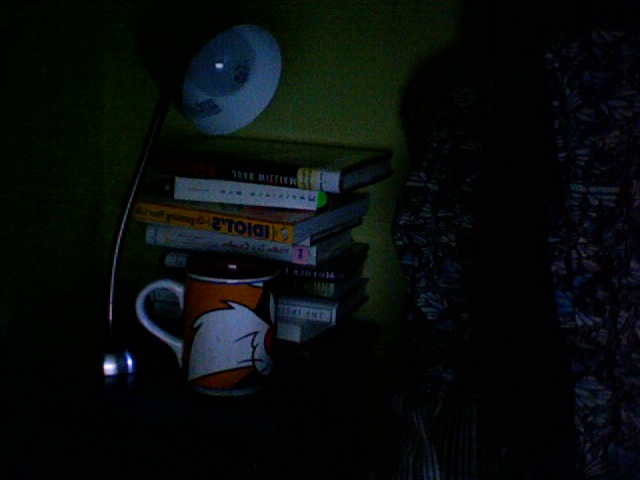
Coffee, three rocks from Canyon Beach, Oregon, and a lamp.
Books: Enough (Juan Williams), Invisible Man (Ellison), the Idiot's Guide to Organizing Your Life, Naked (David Sedaris), The Infinite Gift (Charles Yang), Mother Love (Rita Dove), The Kite Runner.
Saturday, October 28, 2006
Daily Quote From Jeffrey

Father: I love the light in December. The sky is very clear and everything looks sharp.
Jeff: It's a crystal world. It's a pointy world.
38 Things - After Larry Fagin
An idea from Lisa Jarnot's blog "This is an exercise invented by Larry Fagin. You make a list of ultimate pleasing pleasures in life."
1. all birds
2. the Times crossword on Monday, Tuesday, and Wednesday
3. winning
4. the Metropolitian Museum
5. 'real mail'
6. Parker Posey
7. fleet week
8. green chili enchiladas
9. the state of Oregon
10. pedicures
11. going to the movies alone
12. having a lover who is a good cook
13. walking into a warm room from a freezing day
14. the noise of the wind as observed from bed
15. clogs
16. children
17. a strong drink
18. coffee
19. eating out
20. a very clean house
21. the sound of freight trains
22. silence - or its near approximation
23. large swimming pools
24. summer
25. the feeling a crush that cannot be realized
26. randomly helping people
27. a good novel
28. handsome gay men
29. sleep
30. kung fu
31. a good beach
32. going to a party where everyone likes you
33. volvos before 1990
34. realizing it was just a dream
35. a glass of ice water
36. ice skating
37. Mass
38. the light in October in New York
1. all birds
2. the Times crossword on Monday, Tuesday, and Wednesday
3. winning
4. the Metropolitian Museum
5. 'real mail'
6. Parker Posey
7. fleet week
8. green chili enchiladas
9. the state of Oregon
10. pedicures
11. going to the movies alone
12. having a lover who is a good cook
13. walking into a warm room from a freezing day
14. the noise of the wind as observed from bed
15. clogs
16. children
17. a strong drink
18. coffee
19. eating out
20. a very clean house
21. the sound of freight trains
22. silence - or its near approximation
23. large swimming pools
24. summer
25. the feeling a crush that cannot be realized
26. randomly helping people
27. a good novel
28. handsome gay men
29. sleep
30. kung fu
31. a good beach
32. going to a party where everyone likes you
33. volvos before 1990
34. realizing it was just a dream
35. a glass of ice water
36. ice skating
37. Mass
38. the light in October in New York
Thursday, October 26, 2006
Hodgepodge

SLOUCHING TOWARD EXCERCISE
In a week and a half my favorite New York City day of the year arrives - the New York Marathon. Despite my love for my son's kung fu class, I am grossly disinterested in sports. The one exception is the Marathon. I really love the Marathon.
Most years, I don't realize it's happening until the day of the event. The runners go down McGuiness Ave. which is literally one block from my house. I watch it on TV and time it right so that I can hot-foot it down to the race just as the runners are coming down McGuiness to start up the Pulaski Bridge. I love the race because of how it equals the playing field in terms of race, gender, and ability. Of course, there is a "winner" and there are many gold medals athletes. But, there is an entire other thing going on in the marathon with athletes that should be taken no less seriously. People "run" using wheelchairs, on crutches, with cancer, and some just walk most the way. In the spirit of the marathon, spectators get no less excited than when the African men run by. In fact, sometime they get more cheers. And, besides, the African men are maddingly beautiful.
I, myself, am preparing to join in some physical activity. This is highly unusual. My idea of activity is walking to the Mark Bar around the corner. I have tried yoga. In fact, I've been to Kripalu 3 times. But, no matter how kind the instructor and other stundents are, I never feel secure in my body. I always feel like someone is judging me. So, I'm taking up ice skating - no one can do it!
POLITICS
Although I am hardly politically correct and this blog is not a soap box it is difficult not to mention politics. Foley's pageboys are the least of our worries.
Check this out:
From the Dept of Labor's website...
"If you have a disability, you may have trouble finding a job if your disability means you can’t perform at the same level as someone without a disability. Employers may not want to hire you because they think the work you can do doesn’t justify paying you at or above the minimum wage.
The Minimum Wage Act 1983 helps some people with disabilities to get work by allowing Labour Inspectors [from the Department of Labour’s Employment Relations Service] to give minimum wage exemptions. This means a lower minimum wage rate is set for a particular person in a particular job for up to a year."
Did I understand that correctly?
"December 25, 2005 — Company documents show that ORC Industries Inc. is paying at least one nondisabled employee at its Brownsville manufacturing plant below the federal minimum wage, a practice that is against what law and “immoral,” according to labor and civil rights experts.
Another ORC worker who says he has a mental illness, for which he is medicated, also receives less than the minimum $5.15 per-hour wage, even though his illness does not affect his productivity, he said.
Former Secretary of Labor Ray Marshall said paying an able-bodied adult below minimum wage in a manufacturing plant was “obviously illegal” and “immoral.” Civil rights lawyers consulted for this article said the latter instance was a violation of the Americans with Disabilities Act, among other laws.
ORC is a tax-exempt nonprofit that exists to employ the disabled. It receives contracts from the federal government to manufacture military apparel at its Brownsville plant."
Despite documents presented to The Brownsville Herald by ORC employees and interviews with local workers, ORC spokesman Rob Geist wrote in an e-mail, “ORC Industries does not pay nondisabled workers less than minimum wage.”
Yep! Employees are legally allowed to pay workers with disablities below mimumum wage because they are less productive. Funny, I know lots of "normal" people who don't do shit at work - and get a big paycheck!
AND POETRY
Tonight, I am very excited to go see Andrea Baker, Jessica Baran, and Michael Zeiss read for the lauch party for Harp and Altar. Harp and Altar's goal is to publish many poets who have never had anything previously published. I love their motto, Baudelaire's "The poet is of no party."
FINALLY, DAILY QUOTE FROM JEFFREY
Mom: Want to watch TV?
Jeff: Yeah! It's better than reading this boring book!
Tuesday, October 24, 2006
A Novel Idea

I have been cranky for about a week. Last night, I realized the reason. It had been weeks since I had been lost in the world of a novel. Quite accidentally, I happened to start reading Ralph Ellison's "Invisible Man." I have been meaning to read it for 2 years, and I just happened to stumble accross it in the library on Saturday (it's probably the only book we don't own.) Last night, I finished chapter one, and let me tell you - this book's worth every bit of hype.
What I found most interesting is how the opening pages, although written about an African-American rang true for me as a person with a disability. Ellison writes, " I am invisible, simply because people refuse to see me." And then, "I am not complaining, nor am I protesting. It is sometimes advantageous to be unseen, although it is most often rather wearing on the nerves."
Monday, October 23, 2006
A Grand Experiment

In reading Lauterbach's new book of essays, "The Night Sky," she writes:
"Recently, I was introduced as an 'experimental poet.' The adjective was uttered with mild disdain; I felt as though I was being damned with the faintest of praise. In the world of poetry, to be experimental is sometimes taken to mean you have, as the poet Charles Bernstein has remarked, an aversion to form, rather that an adversion to conformity."
I love this quote - but it leads me to ask, in the world of poetry, what is conformity? What is experimental?
I've also heard of small journals that take the opposite stance and attempt to limit themselves to "experimental" poetry. I read in submissions guidelines - if it's narrative at all, don't send it. Also, places that say we don't take poems about 9/11, poems with any grounding, poems about grandmothers and so.
Is there anything wrong with a magazine sticking picking an aesthetic and sticking by it? I can see the lure. It makes your work easier. Submissions are read quickly, and your audience sticks with you because they know what to expect. But, I find the whole thing grossly problematic.
1. Who sets these labels? Define the following words: formal, narrative, lryical, conventional, and experiment? Who gets to pick who's what? Bernstein (one of my favorites) is considered a forerunner of experimental, but many of his poems are narrative. Berrigan is another experimentilist, but he wrote sonnets. And where do Fanny Howe, Seamus Heaney, and Jorie Graham fit?
2. People who exclude are missing out on a lot. It reminds me of the Lower East Sider who brags they never go above 14th Street. Well, that's too bad because The Met and Central Park (not to mention Brooklyn!) are the highlights of New York and they're really missing out. Thus, people who refuse to read Mary Oliver - or people who refuse to read Bernstein.
As poets, we are automatically the outsiders of society. Do we need to do to each other too?
Sunday, October 22, 2006
Brooklyn, Afire

Last night after my son's birthday party - which can only be describe as utter madness. I trudged off to see Kate Greenstreet and Adam Clay read at the art gallery Pierogi in Brooklyn. The reading was fabulous - with two poets with distinct talent.
Matt Hendrickson has a knack for finding talented poets and getting people out for readings. I first saw Kate Greenstreet read nearly a year ago at one such reading. I believe this was her first or second public reading. Since then, her first book, case sensitve has come out, she has read a lot, and her reading style has developed greatly. She read the entire first section of case sensitive, titled Salt. I highly recommend Kate's work. She has just the right mix between the narrative and the lyric. There are moments in her work that grab onto to you, and tell a story. Oher moments the reader floats on her use of language. Matt called it visceral. He was right.
I was startled by the intensity and beauty in Adam Clay's work. Adam is currently studying in the PhD. Creative Writing program at Kalamazoo, Michigan. He is currently studing with Bill Olsen - who was one of my mentors at Vermont College, one of my favorite people, and an unbelievable poet. Clay said that Bill, and his wife, Nancy Eimers are the reason he moved Kalamazoo. I think this connection makes me prejudice toward Clay's poetry. But, even so, I have to say how completely bowled over I was. When I write about interesting work - I keep relying too much on the words lyrical and beautiful, but I use them here again, for lack of better ones. Clay's work reminds me of some of my own favorite poets (Olsen, Jorie Graham, and Mei-Mei Bessenbrugge) who do deep studies in ther beauty of language - but one is does not lose the poem's train of thought. The reader is able to move up and down with the experiment of the poet, but never feel like they are being slighted because the poet is trying to be oblique out of hipness or laziness. Neither is Clay TELLING the reader a story, like many of the more boring narrative poets. The poems have a perfect balance between grounding and mystery.
I think Clay's talent is enormous. The Wash is Clay's first book, and if he remains persistant he will go far.
Saturday, October 21, 2006
Tales of a frustrated housewife/poet

A series of strange circumstances have placed me in a strange position. One which I always hoped for - and dreaded. The obsessive nature of my behavior surrounding my son's fourth birthday party has made a light bulb go off over my head. It's official, I'm a housewife. This role (only for a short period of time in my life) has put me into a talespin. As a person with a disability, I have always prided myself on being able to get out into the world, forge for work, and be very successful. This is sort of a no-man's land that many people (disabled or not) do not fight for. I walked away (temporily) from a 60k a year teaching job because it was, well, just too impossible. Being out of the loop has made me question who I am and what worth I have in the world. This is complecated by the fact that I am a poet.
Housewifery, childcare, and "staying in" to create poetry are things that fit together. Poetry, for me, needs enormous amounts of time to develop, nevermind all the paperwork of sending out and applying to things. Female poets also have a long tradition of motherhood (even the great feminist, Commie, lesbian Murial Rukeyser had a kid). But, what housework, kids, and POETRY have in common most is the marginization of their importance by society. Because I belong to a "group," (what the Times calls "the disabled") that is SO marginalized by society - I have always felt I needed to prove myself outside the home. Now that I'm not currently working I'm a little lost despite the fact that everyone in my family is happier, calmer, and the poetry factory is in running order.
I think all of us could take a lesson from the Shoalin monks. These monks' days are composed of meditating, cooking, sweeping the floor, and doing 6-8 hours of kung fu. Hell, what's the value in that?
Friday, October 20, 2006
Here, I am republishing Jen Benka's review so it will rise to the surface of this strange blog world
What I admire most about Jen Benka is her consistancy. She seems to be able to intertwine her work, political, and poetry lives into one seamless existance. Benka definitely has strong ideas about people who have been historically oppressed - women, poor people, and victims of senseless war. Not only does Benka include these issues her poetry, but like the her great political/poetry predecessors, Rukeyser (of whom Benka adores) and Levertov, human and feminist rights do not only live in the empherphemal idea of her poetry, but seep out into the concrete daily life. As such, Benka has worked for non-profits that help homeless people and women. She has tirelessly taken on projects of grand proportions to such as the recent "Finally with Women" series to make sure that some of our finest writers (Rukeyser, Guest, Stein, Loy, and so on) continue to be recognized. In short, she seems to be in the great tradition of poets that not only challenge injustice through writing, but also through concrete activism.
Of the poems.
Political poetry has always been problematic. The ulitimate goal of poetry is to develop and experiment with language and beauty. In political poetry (such as that of Baraka and some slam poetry)the tendency is to fall too much into a rah! rah! rah! mentality. The sentiment is there: The poetry is not. The two aformentioned great political poets (Rukeyser and Levertov) were able to guard against this simplification in their poetry as they faced issues of war, racism, and hatred. Benka accomplishes simuliar goal with beauty and humor to spare.
Benka the 52 words that comprise the Preamble to the U.S. Constitution. Yet, this is not quite what our forepeople had in mind. It's a land united in "the inevitability of betrayal."
It's Liberty arrives
when they struck the bell it cracked in half
and fell from its high tower.
the crowd below once full of hope
never knew what hit them.
Without ignoring the beauty of our home:
THIS
light;
a warm peach
melting.
And my favor poem in the book. Welfare - a word that obviously takes on multiple meanings. Here a girl on the stoop (on disability payments) mocks the "puerto rican girls" on welfare.
I urge soft skull to print more of Benka's book and drop it from an airplane over the red states. And poets, continue our work.
Of the poems.
Political poetry has always been problematic. The ulitimate goal of poetry is to develop and experiment with language and beauty. In political poetry (such as that of Baraka and some slam poetry)the tendency is to fall too much into a rah! rah! rah! mentality. The sentiment is there: The poetry is not. The two aformentioned great political poets (Rukeyser and Levertov) were able to guard against this simplification in their poetry as they faced issues of war, racism, and hatred. Benka accomplishes simuliar goal with beauty and humor to spare.
Benka the 52 words that comprise the Preamble to the U.S. Constitution. Yet, this is not quite what our forepeople had in mind. It's a land united in "the inevitability of betrayal."
It's Liberty arrives
when they struck the bell it cracked in half
and fell from its high tower.
the crowd below once full of hope
never knew what hit them.
Without ignoring the beauty of our home:
THIS
light;
a warm peach
melting.
And my favor poem in the book. Welfare - a word that obviously takes on multiple meanings. Here a girl on the stoop (on disability payments) mocks the "puerto rican girls" on welfare.
I urge soft skull to print more of Benka's book and drop it from an airplane over the red states. And poets, continue our work.
Sunday, October 15, 2006
Little Children
On Friday, Jim and I got to see a rare movie. We saw the film "Little Children" about the supposed boring lives of mothers (and fathers) of suburbia. Strangely ironic, New York magazine had been interviewing people at our park earlier that afternoon. They didn't approach me because I'm too dirty looking - but they did make a bee-line for my best friend at the park - the very handsome, sexy, gay, 24 yr old neighhborhood babysitter. Afterwards, I asked him excitedly what they had asked. He told me, "Oh, they weren't interested in me. They wanted parents, and they wanted to know if any of the parents were having affairs." He told them - Hell if I know, I'm just the babsitter! Then, they asked him if any of the parents hit on him. "I said ....a no...."
I liked the film. But, what I'm curious about this mytholgy that parents have very boring lives and have to screw each other for entertainment. Obviously, this myth exists mainly in the suburbs and I live in the city - but, why would New York magazine be lurking for the scandel if they didn't believe some of this had envaded the streets of, well, Brooklyn.
From my experience, New York Magazine is off to the wrong start. I know A LOT of parents - ranging from stay-at-home to work 24 hrs. a day. Here is a list of their jobs:
Video artist/political blogger
Bar Owner
High paid Computer Mavin
Lawyer
Painter/ Professor
Senior person at Real Simple
PhD. Canidate in Poetry
Construction Woker/ Sci Fi Writer
Math Teacher/ Sci Fi Writer
Poet
Poet/ Professor
Admin. Assistant
Wood Carver for Museum Frames
Musician
Architect
Record Store owner
Junk Shop Owner
Assistant to Director of Admissions at a major private school
Owner of 2 Restuarants
Jewelry Designer for W
Journalist
P.S. All the parents seem really in love - what a concept!
I liked the film. But, what I'm curious about this mytholgy that parents have very boring lives and have to screw each other for entertainment. Obviously, this myth exists mainly in the suburbs and I live in the city - but, why would New York magazine be lurking for the scandel if they didn't believe some of this had envaded the streets of, well, Brooklyn.
From my experience, New York Magazine is off to the wrong start. I know A LOT of parents - ranging from stay-at-home to work 24 hrs. a day. Here is a list of their jobs:
Video artist/political blogger
Bar Owner
High paid Computer Mavin
Lawyer
Painter/ Professor
Senior person at Real Simple
PhD. Canidate in Poetry
Construction Woker/ Sci Fi Writer
Math Teacher/ Sci Fi Writer
Poet
Poet/ Professor
Admin. Assistant
Wood Carver for Museum Frames
Musician
Architect
Record Store owner
Junk Shop Owner
Assistant to Director of Admissions at a major private school
Owner of 2 Restuarants
Jewelry Designer for W
Journalist
P.S. All the parents seem really in love - what a concept!
Saturday, October 14, 2006
The Symphony of Edwin Torres
On Thursday night I escaped briefly to go see Edwin Torres at the Bowery Poetry Club.
Edwin is one of my husband and my (mine) favorite poets. The thing we adore about Edwin is his flexibility within the world of language. Edwin's work defies definition in a genre in which people are so eager to label. He writes a radio play, a narrative-ish poem, a lyric, a slam poem, a nonsense poem - and does it all famously. I have always been skeptical of poets/artists who move into different directions. How can a someone be good at something if they don't obsessively stick with that one thing? Torres defies this skepticism - he is interesting. Period.
What I also like about Edwin is his nonchalant attitude and humbleness about his talent. This is a quality I find in of my many poet-friends. I can not say how much I respect this attitude, in a land of high, high egos. I have always found it difficult to balance the ideas of immense talent, self-promotion, and humility (or just plain niceness) as an artist. Torres and some others (Durand, Coultras, Berrigan, Benka to name a few) have suceeded in this.
So -
On Thursday, Torres led a smaall group of us in what he described as
I HEAR THINGS: Part One
A Poets' Symphony with you, the audience, conducted under
the baton of Maestro Edwin Torres. One classic/one
contemporary poem per night.
Torres admittly didn't event the idea, but chose to play around with it. It involved the audience reading three poems together. As we all have different voices, we all moved at different speeds. Torres had us "substain" notes and repeat segments - while the ohters did different vocals with the poem. The difference between Torres performance and others is that his was not rehearsed, rather with the audience cold from off the street. The results were beautiful.
Edwin is one of my husband and my (mine) favorite poets. The thing we adore about Edwin is his flexibility within the world of language. Edwin's work defies definition in a genre in which people are so eager to label. He writes a radio play, a narrative-ish poem, a lyric, a slam poem, a nonsense poem - and does it all famously. I have always been skeptical of poets/artists who move into different directions. How can a someone be good at something if they don't obsessively stick with that one thing? Torres defies this skepticism - he is interesting. Period.
What I also like about Edwin is his nonchalant attitude and humbleness about his talent. This is a quality I find in of my many poet-friends. I can not say how much I respect this attitude, in a land of high, high egos. I have always found it difficult to balance the ideas of immense talent, self-promotion, and humility (or just plain niceness) as an artist. Torres and some others (Durand, Coultras, Berrigan, Benka to name a few) have suceeded in this.
So -
On Thursday, Torres led a smaall group of us in what he described as
I HEAR THINGS: Part One
A Poets' Symphony with you, the audience, conducted under
the baton of Maestro Edwin Torres. One classic/one
contemporary poem per night.
Torres admittly didn't event the idea, but chose to play around with it. It involved the audience reading three poems together. As we all have different voices, we all moved at different speeds. Torres had us "substain" notes and repeat segments - while the ohters did different vocals with the poem. The difference between Torres performance and others is that his was not rehearsed, rather with the audience cold from off the street. The results were beautiful.
Friday, October 13, 2006
Poets of the World - Unite and Take Over
I am lapsing momentarily away from my essay to post a few things I've been considering.
I got this line from my good friend Tara O'Connor this morning in reaction to the essay - "I have to admit I am part of the group that was taught to read into poetry for meaning, not to read it on an emotional level." I think this has reached crisis proportions in America. I am putting a call out to all poets to reverse the trend. Let's start in the lower grades to teach children to read poetry for fun, emotion, and beauty. I actually "taught" myself to read poetry at age 20. I found that this was the key to doing it. Once I learned the payback was immeasurable.
One night I was laying in bed, depressed (as usual) about my faults. A line from Mary Oliver seeped into my head "You do not have to be good." Sometimes looking at my son, I think of Kinnell's poems about his children. My life would be so less rich without these poems to refer back to.
Andrea Baker (I hope it's not a secret) is starting a program at her son's school where poetry isn't just read as poetry - it's intregrated into daily studies and daily life. This a very Russian approach - and very crucial. I want to do something simuliar at my own son's school. Poets - by nature - are so exclusionary. They want to exclude the world and each other. They want to devide- I'm this school, you're that - they want to be cooly oblique and purposefully difficult. I am calling all poets to start including!
I got this line from my good friend Tara O'Connor this morning in reaction to the essay - "I have to admit I am part of the group that was taught to read into poetry for meaning, not to read it on an emotional level." I think this has reached crisis proportions in America. I am putting a call out to all poets to reverse the trend. Let's start in the lower grades to teach children to read poetry for fun, emotion, and beauty. I actually "taught" myself to read poetry at age 20. I found that this was the key to doing it. Once I learned the payback was immeasurable.
One night I was laying in bed, depressed (as usual) about my faults. A line from Mary Oliver seeped into my head "You do not have to be good." Sometimes looking at my son, I think of Kinnell's poems about his children. My life would be so less rich without these poems to refer back to.
Andrea Baker (I hope it's not a secret) is starting a program at her son's school where poetry isn't just read as poetry - it's intregrated into daily studies and daily life. This a very Russian approach - and very crucial. I want to do something simuliar at my own son's school. Poets - by nature - are so exclusionary. They want to exclude the world and each other. They want to devide- I'm this school, you're that - they want to be cooly oblique and purposefully difficult. I am calling all poets to start including!
Tuesday, October 03, 2006
Review: a box full of longing with fifty drawers by Jen Benka
What I admire most about Jen Benka is her consistancy. She seems to be able to intertwine her work, political, and poetry lives into one seamless existance. Benka definitely has strong ideas about people who have been historically oppressed - women, poor people, and victims of senseless war. Not only does Benka include these issues her poetry, but like the her great political/poetry predecessors, Rukeyser (of whom Benka adores) and Levertov, human and feminist rights do not only live in the empherphemal idea of her poetry, but seep out into the concrete daily life. As such, Benka has worked for non-profits that help homeless people and women. She has tirelessly taken on projects of grand proportions to such as the recent "Finally with Women" series to make sure that some of our finest writers (Rukeyser, Guest, Stein, Loy, and so on) continue to be recognized. In short, she seems to be in the great tradition of poets that not only challenge injustice through writing, but also through concrete activism.
Of the poems.
Political poetry has always been problematic. The ulitimate goal of poetry is to develop and experiment with language and beauty. In political poetry (such as that of Baraka and some slam poetry)the tendency is to fall too much into a rah! rah! rah! mentality. The sentiment is there: The poetry is not. The two aformentioned great political poets (Rukeyser and Levertov) were able to guard against this simplification in their poetry as they faced issues of war, racism, and hatred. Benka accomplishes simuliar goal with beauty and humor to spare.
Benka the 52 words that comprise the Preamble to the U.S. Constitution. Yet, this is not quite what our forepeople had in mind. It's a land united in "the inevitability of betrayal."
It's Liberty arrives
when they struck the bell it cracked in half
and fell from its high tower.
the crowd below once full of hope
never knew what hit them.
Without ignoring the beauty of our home:
THIS
light;
a warm peach
melting.
And my favor poem in the book. Welfare - a word that obviously takes on multiple meanings. Here a girl on the stoop (on disability payments) mocks the "puerto rican girls" on welfare.
I urge soft skull to print more of Benka's book and drop it from an airplane over the red states. And poets, continue our work.
Of the poems.
Political poetry has always been problematic. The ulitimate goal of poetry is to develop and experiment with language and beauty. In political poetry (such as that of Baraka and some slam poetry)the tendency is to fall too much into a rah! rah! rah! mentality. The sentiment is there: The poetry is not. The two aformentioned great political poets (Rukeyser and Levertov) were able to guard against this simplification in their poetry as they faced issues of war, racism, and hatred. Benka accomplishes simuliar goal with beauty and humor to spare.
Benka the 52 words that comprise the Preamble to the U.S. Constitution. Yet, this is not quite what our forepeople had in mind. It's a land united in "the inevitability of betrayal."
It's Liberty arrives
when they struck the bell it cracked in half
and fell from its high tower.
the crowd below once full of hope
never knew what hit them.
Without ignoring the beauty of our home:
THIS
light;
a warm peach
melting.
And my favor poem in the book. Welfare - a word that obviously takes on multiple meanings. Here a girl on the stoop (on disability payments) mocks the "puerto rican girls" on welfare.
I urge soft skull to print more of Benka's book and drop it from an airplane over the red states. And poets, continue our work.
Friday, September 29, 2006
Apropos of absence of personality: I want to start with these lines from
"In a Shadow Gate"
by Paul Hoover
Because it has rained and the TV
in on, the world is not itself.
No setting, no plot, no stable
sense of others, yet the vaguest
scent of events absorbs or rather
emits the earthly smell of light.
The woman writes, as if in space:
The boy shines in the house.
The meaning of the sentence
arrives like a shroud or a mouth.
North of her eyes, desirable objects
occupy a blank page of heaven.
------------------------------
I don’t believe that Palmer means, as some LP might, that “personality” can be obliterated in the poem per se. I think he might agree that ALL poems: confessional, language, abstract, or otherwise are somewhat grounded in personality simply because a human wrote them. Even Stein’s work has her signature all over it. Therefore, “personality” is never completely erased. Rather, Palmer is “interested in an attempt to return to the physicality of the WORD AS GESTURE, as an embodiment of the VARIETY of selves and non-selves which propose themselves as language on the page.” Meaning that poetry is not a condensation of other forms (i.e. prose). Or as Bernstein puts it, “That is, in prose you start with the world/ And you find the words to match: in poetry you start with the words and find the world in them.”
More about word as gesture in a moment. First, two poems.
Dearest Reader by Michael Palmer
He painted the mountain over and over again
from his place in the cave, agape
at the light, its absence, the mantled
skull with blue-tinted hollows, wren-
like bird plucking berries from the fire
her hair alight and so on
lemon grass in cafe in clear glass.
Dearest reader there were trees
formed of wire, broad entryways
beneath balconies beneath spires
youthful head come to rest in meadow
beside bend in gravel road, still
body of milky liquid
her hair alight and so on
successive halls, flowered carpets and doors
or the photograph of nothing but pigeons
and grackles by the shadow of a fountain.
------------------------------
Grandmother in the Garden
Louise Gluck
Grandmother in the Garden
Louise Gluck
The grass below the willow
Of my daughter's wash is curled
With earthworms, and the world
Is measured into row on row
Of unspiced houses, painted to seem real.
The drugged Long Island summer sun drains
Pattern from those empty sleeves, beyond my grandson
Squealing in his pen. I have survived my life.
The yellow daylight lines the oak leaf
And the wire vines melt with the unchanged changes
Of the baby. My children have their husbands' hands.
My husband's framed, propped bald as a baby on their pianos,
My tremendous man. I close my eyes. And all the clothes
I have thrown out come back to me, the hollows
Of my daughters' slips...they drift; I see the sheer
Summer cottons drift, equivalent to air.
"In a Shadow Gate"
by Paul Hoover
Because it has rained and the TV
in on, the world is not itself.
No setting, no plot, no stable
sense of others, yet the vaguest
scent of events absorbs or rather
emits the earthly smell of light.
The woman writes, as if in space:
The boy shines in the house.
The meaning of the sentence
arrives like a shroud or a mouth.
North of her eyes, desirable objects
occupy a blank page of heaven.
------------------------------
I don’t believe that Palmer means, as some LP might, that “personality” can be obliterated in the poem per se. I think he might agree that ALL poems: confessional, language, abstract, or otherwise are somewhat grounded in personality simply because a human wrote them. Even Stein’s work has her signature all over it. Therefore, “personality” is never completely erased. Rather, Palmer is “interested in an attempt to return to the physicality of the WORD AS GESTURE, as an embodiment of the VARIETY of selves and non-selves which propose themselves as language on the page.” Meaning that poetry is not a condensation of other forms (i.e. prose). Or as Bernstein puts it, “That is, in prose you start with the world/ And you find the words to match: in poetry you start with the words and find the world in them.”
More about word as gesture in a moment. First, two poems.
Dearest Reader by Michael Palmer
He painted the mountain over and over again
from his place in the cave, agape
at the light, its absence, the mantled
skull with blue-tinted hollows, wren-
like bird plucking berries from the fire
her hair alight and so on
lemon grass in cafe in clear glass.
Dearest reader there were trees
formed of wire, broad entryways
beneath balconies beneath spires
youthful head come to rest in meadow
beside bend in gravel road, still
body of milky liquid
her hair alight and so on
successive halls, flowered carpets and doors
or the photograph of nothing but pigeons
and grackles by the shadow of a fountain.
------------------------------
Grandmother in the Garden
Louise Gluck
Grandmother in the Garden
Louise Gluck
The grass below the willow
Of my daughter's wash is curled
With earthworms, and the world
Is measured into row on row
Of unspiced houses, painted to seem real.
The drugged Long Island summer sun drains
Pattern from those empty sleeves, beyond my grandson
Squealing in his pen. I have survived my life.
The yellow daylight lines the oak leaf
And the wire vines melt with the unchanged changes
Of the baby. My children have their husbands' hands.
My husband's framed, propped bald as a baby on their pianos,
My tremendous man. I close my eyes. And all the clothes
I have thrown out come back to me, the hollows
Of my daughters' slips...they drift; I see the sheer
Summer cottons drift, equivalent to air.
Tuesday, September 26, 2006
So-Called Language Poetry and Beyond
I have been very interested for many years about how the so-called Language Poetry movement has formed and re-formed poetry in the last 15-20 years. Recently, while searching for places to submit, I came upon a magazine which (although eact wording alludes me) claimed that they are completely uninterested in even considering any work with narrative. Okay. But, is this quite what Silliman, Palmer, Berstein, Andrews, Watten, Heijinian and some others had in mind?
I have decided - just for fun! - to post installments of a paper I gave to a heavily-narrative based school on a sort of history of "Language Poetry."
The first installment later today - or tommorrow.
I have decided - just for fun! - to post installments of a paper I gave to a heavily-narrative based school on a sort of history of "Language Poetry."
The first installment later today - or tommorrow.
Friday, September 22, 2006
Madrid, Beauty, and Women Poets

If you follow the news, you’ve probably heard the rumblings in the fashion world.
From today’s New York Times: “Organizers of Madrid’s Fashion Week caught designer and fashionista scorn for banning the unreasonably thin from their show. The Madrid standard: a minimum body mass index of at least 18 — a measure of body fat based on weight and height. A reading of 18 is still underweight (18.5 to just under 25 is considered normal), but it is outsized among the ranks of supermodels, many of whom hover between 14 and 16.” I congratulate Madrid’s bravery in putting a crunch on a industry the encourages women/girls to starve themselves and society to judge people by their looks. To change this engrained way of thinking would deeply damage the U.S. economy. Think of how many hair salons, make-up giants, gyms, diet book writers, and plastic surgeons would be out of business.
What on earth does this have to do with the poetry world? I would argue, not exclusively but somewhat, as un-feminist as it sounds, that better looking women have more of a chance of becoming successful poets. Perhaps this started in the fifties with the fashion-model duo of Sylvia and Anne. A poet having their photograph on their book is a relatively new practice. It started (more or less) with Carolyn Forche’ in 1982 with The Country Between Us. Forche’ (who is a GREAT poet and quite a looker, by the way) not only had the dreamy, long-haired beautiful poet portrait on her book – but it was the cover! This paved the way for APR’s and publishers' habit of including a photo with poems. There is nothing wrong with this, but I do think it skews the playing field a little (see: Rukeyser and Niedecker).
I’m not against feminine wiles as a concept. If I were, I’d be paying my car mechanic a lot more. However, I think we could all stand to have a little more Pynchon in the poetry world. Shouldn’t poetry be based on, well, poetry.
Wednesday, September 20, 2006
Visual Art and Poetry

I can’t remember not being interested in visual art.
From the time I was a small child, I wrote. I made up stories and plays and typed them on my great-grandmother’s 1910 typewriter. This was largely born out of a childhood with absolutely NOTHING to do. We lived in boring towns, and my parents, who had five kids and little money, pretty much left entertainment up to us. Despite the writing, I always remember being interested in painting. (Interestingly, it never even crossed my mind to be a painter). My interest grew when I went to the University of New Mexico and started a series of grueling art history classes in which we had to memorize the names of paintings, artists, stories, and so on. What might be mind numbing for some was my definition of bliss. And I thought I was fabulous to have all this information in my head. Still, at the ripe age of 18, I had never really seen a “real” painting (or other) other than O’Keefe. This helped prompt my first trip to New York, my four year career at the MFA, Boston, and eventually, my permanent move to New York.
Art has informed my poetry in the most pronounced way. I write about paintings, film, and photographs often -- my forthcoming book is called Derivative of the Moving Image. I write in museums. Curiously, as I have anxiety and depression and am often mentally uncomfortable, museums calm me down and can often bring me to a state of bliss. Despite all the bad politics, I thing my job at the MFA was the only “right” job I ever had (and there have been plenty!).
I know I’m a LITTLE unusual, but not solitary in this equation. Ashbery was an art critic. O’Hara spend years working at MOMA (if memory serves right – he started as a guard and became a curator. Berstein is married to a wonderful artist - Susan Bee. Clemente worked with Ginsberg and Creeley. Jorie Graham slips painting into her art on a regular basis and was trained in film.
Some of my favorite painters are Warhol, Basquiat, Charlotte Solomon, Cy Twombly, Lucien Freud, Kiki Smith, Rothko, Pollock, Milton Avery, and Clemete.
Sunday, September 17, 2006
Finally!
We are proud to welcome you a fourth issue of Saint Elizabeth Street. This has been a long time in coming. (Two or three years!) Unfortunately, life often gets in the way of poetry. And art in all forms comes very, very slow. We apologize in advance for any typos, miscommunications, offensive, and confusing text, or unanswered letters. Enjoy!
Jennifer Bartlett, Editor
Jim Stewart, Designer
Jeffrey, Muffin, Lucy, Copy Editors
Jennifer Bartlett, Editor
Jim Stewart, Designer
Jeffrey, Muffin, Lucy, Copy Editors
Wednesday, September 13, 2006
The Disabled
I have written many letters to the Times regarding their use of the term “the disabled” which is one of my pet-peeves. These letters have come to no avail. Last night, while speaking to my husband Jim, I realized why this terminology gets to me. As with “The Blacks,” “The gays,” or “The Jews,” this terminology takes a group of people and lumps them all together for convenience (or laziness) sake based on one quality. This is very dehumanizing and inaccurate.
Let’s pick on “the gays” for a moment. One on end, you’ve got the guys on Queer Eye for the Straight Guy. On the other end, there’s my dear friend who loves ice hockey, has never decorated anything, and dresses like a homeless Vassar student. What do these men have in common? Precious little!
When it comes to “the disabled” the terminology gets even more bizarre and diluted. When one writes “the disabled” what does he/she mean? Do they mean CP, MS, deafness, depression, autism, blindness or paralysis? I would even argue that HIV, epilepsy, cancer, and being a Republican are disabilities. Why not be specific? If someone is referring to a problem with a lack of curb-cuts, why not call those affected “people who use wheelchairs.” I mean I’m disabled and I never use a curb-cut and I doubt people with autism have trouble with them either.
That said, ironically, I am adamantly against the politically correct movement. I view such as some people making up words such as “differently abled” that they don’t really buy into just to make themselves feel better or superior. But, I do think that writers (especially those in the Times!) have a responsibility to examine the language in detail and, most important, to say what they mean.
Let’s pick on “the gays” for a moment. One on end, you’ve got the guys on Queer Eye for the Straight Guy. On the other end, there’s my dear friend who loves ice hockey, has never decorated anything, and dresses like a homeless Vassar student. What do these men have in common? Precious little!
When it comes to “the disabled” the terminology gets even more bizarre and diluted. When one writes “the disabled” what does he/she mean? Do they mean CP, MS, deafness, depression, autism, blindness or paralysis? I would even argue that HIV, epilepsy, cancer, and being a Republican are disabilities. Why not be specific? If someone is referring to a problem with a lack of curb-cuts, why not call those affected “people who use wheelchairs.” I mean I’m disabled and I never use a curb-cut and I doubt people with autism have trouble with them either.
That said, ironically, I am adamantly against the politically correct movement. I view such as some people making up words such as “differently abled” that they don’t really buy into just to make themselves feel better or superior. But, I do think that writers (especially those in the Times!) have a responsibility to examine the language in detail and, most important, to say what they mean.
Tuesday, September 12, 2006
100 poems/poetry books to be read immediately contined
15. Like the Wind Loves a Window Andrea Baker
16. "What the Living Do" Marie Howe
17. The Grand Permission ed. Brenda Hillman
18. Talking Poetry ed. Lee Bartlett
19. "Little Sleep's-Head Sprouting Hair in the Moonlight Galway Kinnell
20. "Impressionism" Jorie Graham (Harvard Review #27)
21. Code of Silences ed. Michael Palmer
22. Letters to a Young Poet Rilke
23. "Wild Geese" Mary Oliver
24. The Greenhouse Effect Lee Bartlett
25. Cascadia Brenda Hillman
26. Selected Poems Barbra Guest
27. Ariel Sylvia Plath
28. readiness enough depends on Larry Eigner
29. The Book of Tendons Eleni Sikelianos
30. The Biography of Anne Sexton (forgot author)
31. View with a Grain of Sand Wislawa Szymorska
16. "What the Living Do" Marie Howe
17. The Grand Permission ed. Brenda Hillman
18. Talking Poetry ed. Lee Bartlett
19. "Little Sleep's-Head Sprouting Hair in the Moonlight Galway Kinnell
20. "Impressionism" Jorie Graham (Harvard Review #27)
21. Code of Silences ed. Michael Palmer
22. Letters to a Young Poet Rilke
23. "Wild Geese" Mary Oliver
24. The Greenhouse Effect Lee Bartlett
25. Cascadia Brenda Hillman
26. Selected Poems Barbra Guest
27. Ariel Sylvia Plath
28. readiness enough depends on Larry Eigner
29. The Book of Tendons Eleni Sikelianos
30. The Biography of Anne Sexton (forgot author)
31. View with a Grain of Sand Wislawa Szymorska
Monday, September 11, 2006
September 9, 2001, A Letter to my other Jim
When a really bad thing happens the amazing thing to me is not only how terrible the thing is itself, but how unexpected. This is the feeling I remember most as I go through my own personal tragedies: the deaths of my young boyfriend (Ashley), sister (Emma), and stepmother (Saint Elizabeth). More recently, on a much more mundane level, my son’s first real injury: a cut on a can, lots of blood, a trip to NYU ER and four stitches. What I remember about all these events is how vividly ordinary the moments before the news was and how I keep replaying these moments to see if I could stop or change the event. I have a real sense of what the world felt like before and after.
This is the exact feeling I have about September 11, 2001. It is for this reason that I want to write about the day or so before the tragedy, rather than the day itself. September 9, 2001 was one such day – that was both magical and ordinary. In the morning I met my good friend, the artist Jim Campbell, to do a video shoot on the beach in Montauk. We met near Grand Central Station and took the bus out onto Long Island. During the nearly three-hour ride we drank coffee and talked about sex, marriage, and art. His wife picked us up at the bus stop and we drove through the estates of the Hamptons the wealthy friend’s house where she was staying. I remember being most interested in the swimming pool – keeping with my own bizarre obsession. Then, Jim and I went to the beach. Jim’s idea turned out to be grueling for me. As I have cerebral palsy, Jim’s idea was to catch my movement on video, later to be transformed into LTD lights in a sort of oblique portrait. What he required of me was to run in the sand in a circle completely clothed in black and black socks – no shoes. It was difficult, hot, and exciting. I think I slept on the way home.
The next (was it Tuesday?) I arrived at Intermediate School 49 in East Williamsburg to help set up our school. It was my second week officially (of five difficult years) with the DOE, but with no students yet. What I keep relentlessly remembering is how perfectly blue the sky was that day – just like today. It’s this impossible clear blue that I’ve actually only noticed in New York City.
Jim, who lives in the Bay Area, would later tell me of Sept. 11th that he was glad to have been in NY when "the accident" occured. As a someone who is very attached to her hometown, I knew what he meant. To be far away and in an endless state of wondering what REALLY happened would have been infinetly worse. Five years later, both Jim and I have a child (with separate spouses!). I have fled the Department of Education. The Metropolitan Museum of Art bought the Ambigous Icon – after MOMA deemed it too un-politically correct. Jim makes art. I write. We go on.
This is the exact feeling I have about September 11, 2001. It is for this reason that I want to write about the day or so before the tragedy, rather than the day itself. September 9, 2001 was one such day – that was both magical and ordinary. In the morning I met my good friend, the artist Jim Campbell, to do a video shoot on the beach in Montauk. We met near Grand Central Station and took the bus out onto Long Island. During the nearly three-hour ride we drank coffee and talked about sex, marriage, and art. His wife picked us up at the bus stop and we drove through the estates of the Hamptons the wealthy friend’s house where she was staying. I remember being most interested in the swimming pool – keeping with my own bizarre obsession. Then, Jim and I went to the beach. Jim’s idea turned out to be grueling for me. As I have cerebral palsy, Jim’s idea was to catch my movement on video, later to be transformed into LTD lights in a sort of oblique portrait. What he required of me was to run in the sand in a circle completely clothed in black and black socks – no shoes. It was difficult, hot, and exciting. I think I slept on the way home.
The next (was it Tuesday?) I arrived at Intermediate School 49 in East Williamsburg to help set up our school. It was my second week officially (of five difficult years) with the DOE, but with no students yet. What I keep relentlessly remembering is how perfectly blue the sky was that day – just like today. It’s this impossible clear blue that I’ve actually only noticed in New York City.
Jim, who lives in the Bay Area, would later tell me of Sept. 11th that he was glad to have been in NY when "the accident" occured. As a someone who is very attached to her hometown, I knew what he meant. To be far away and in an endless state of wondering what REALLY happened would have been infinetly worse. Five years later, both Jim and I have a child (with separate spouses!). I have fled the Department of Education. The Metropolitan Museum of Art bought the Ambigous Icon – after MOMA deemed it too un-politically correct. Jim makes art. I write. We go on.
Sunday, September 10, 2006
Our Man Michael Palmer!
Finally, there seems to be justice in the ever-wacky poetry world. Michael Palmer has just been awarded the Wallace Stevens Award by the Academy of American Poets. The prize has been in existence since 1994 and carries a purse of $100,000. This news makes me ecstatic for two reasons.
In short, Palmer is my favor living poet. In a review of his work for the Harvard Review I called him “one of America’s most important poets….startingly lyrical and visceral.” New Directions has since used this quote in blurbs for Palmer’s subsequent books. To describe his work as thus is quite exact and the thing that makes Palmer so magically talented. His work defies borders. It tells a story, but is not narrative. It is maniacally lyrical and beautiful, but relentlessly experimental. He is considered a forerunner of “so-called Language Poetry,” but he himself dismisses this title. His work is much different from Bernstein, Andrews, Rae Armantrout, and somehow similar too. The work laughs in the face of categories to which many poets desperately cling.
The Academy of American Poets and the mainstream public have their opinion of what is and isn’t “good poetry” as much as young poets and editors. This is to the extent that the “mainstream” reads poetry – which everyone reading this will know is a joke! I had a disagreement some months ago with some poets as to whether Palmer is marginalized or underrated. All disagreed with me. However, what I meant was that Palmer in marginalized in terms of what Americans regard as major poets. One only has to look at the Award’s past recipients to see what I mean: Gerald Stern, Mark Strand, Richard Wilbur, James Tate, and so on. These are largely narrative accessible poets. The exceptions were Ashbery (you have to give him an award for something!) and Jackson Mac Low (another liberal leap for the Academy whose judges that year included Creeley, Perloff, and Yau). These are all fine poets. My point is that readers are not exactly going to see a Palmer poem on the bus next to Angelou and Bishop.
Perhaps this award will help expand all of our opinions of what can be great poetry can and should be. If not, oh well! Mr. Palmer, you’ve got the money and you surely deserve it! Enjoy!
In short, Palmer is my favor living poet. In a review of his work for the Harvard Review I called him “one of America’s most important poets….startingly lyrical and visceral.” New Directions has since used this quote in blurbs for Palmer’s subsequent books. To describe his work as thus is quite exact and the thing that makes Palmer so magically talented. His work defies borders. It tells a story, but is not narrative. It is maniacally lyrical and beautiful, but relentlessly experimental. He is considered a forerunner of “so-called Language Poetry,” but he himself dismisses this title. His work is much different from Bernstein, Andrews, Rae Armantrout, and somehow similar too. The work laughs in the face of categories to which many poets desperately cling.
The Academy of American Poets and the mainstream public have their opinion of what is and isn’t “good poetry” as much as young poets and editors. This is to the extent that the “mainstream” reads poetry – which everyone reading this will know is a joke! I had a disagreement some months ago with some poets as to whether Palmer is marginalized or underrated. All disagreed with me. However, what I meant was that Palmer in marginalized in terms of what Americans regard as major poets. One only has to look at the Award’s past recipients to see what I mean: Gerald Stern, Mark Strand, Richard Wilbur, James Tate, and so on. These are largely narrative accessible poets. The exceptions were Ashbery (you have to give him an award for something!) and Jackson Mac Low (another liberal leap for the Academy whose judges that year included Creeley, Perloff, and Yau). These are all fine poets. My point is that readers are not exactly going to see a Palmer poem on the bus next to Angelou and Bishop.
Perhaps this award will help expand all of our opinions of what can be great poetry can and should be. If not, oh well! Mr. Palmer, you’ve got the money and you surely deserve it! Enjoy!
Thursday, September 07, 2006
Factotum
For my husband’s birthday we went to see Factotum, the film based on the novel by Charles Bukowski. I have very limited knowledge of Bukowski’s work. What I have read, I haven’t been much impressed with. The film made me want to give his work – at least this novel – more of a chance.
While I was watching the film, I really hated it, despite the fact that three of my favorite actors were in it and the acting was fabulous. What I had trouble stomaching was Dillon and Taylor’s total disregard for civility and the film’s glamorization it. What I mean to say is that there is nothing cool about waking up, vomiting, and reaching for another drink. I think films/books about alcoholics touch a nerve in many poets/artists who drink. One always walks away wondering: Am I this bad? Will I become this bad? And one is left with a sense of paranoia.
As time passes however, I find that I truly loved the film. I think Bukwoski had a wonderful, relentless attitute toward writing that is unbelievably inspiring. In the final scene, Henry (the writer) is sitting alone with a drink in a strip bar. He gives this wonderful monolugue about how if you are going to do "it" (it meaning writing, hopefully, not drinking!) you have to go all the way. He says something to the effect that you may lose lovers, wives, your family, all your money, and if you go on long enough, you will lose your mind. But, once you get there, nothing could be better. I think these are the words of a true writer. Someone who writes not for the small doses of money or popularity it brings, but because they have no choice. Ironically, Bukoski wasn’t THAT good of a writer. Rather, he was a fastitous self-promoter. But, he had the most important thing an artist can have: blind faith.
While I was watching the film, I really hated it, despite the fact that three of my favorite actors were in it and the acting was fabulous. What I had trouble stomaching was Dillon and Taylor’s total disregard for civility and the film’s glamorization it. What I mean to say is that there is nothing cool about waking up, vomiting, and reaching for another drink. I think films/books about alcoholics touch a nerve in many poets/artists who drink. One always walks away wondering: Am I this bad? Will I become this bad? And one is left with a sense of paranoia.
As time passes however, I find that I truly loved the film. I think Bukwoski had a wonderful, relentless attitute toward writing that is unbelievably inspiring. In the final scene, Henry (the writer) is sitting alone with a drink in a strip bar. He gives this wonderful monolugue about how if you are going to do "it" (it meaning writing, hopefully, not drinking!) you have to go all the way. He says something to the effect that you may lose lovers, wives, your family, all your money, and if you go on long enough, you will lose your mind. But, once you get there, nothing could be better. I think these are the words of a true writer. Someone who writes not for the small doses of money or popularity it brings, but because they have no choice. Ironically, Bukoski wasn’t THAT good of a writer. Rather, he was a fastitous self-promoter. But, he had the most important thing an artist can have: blind faith.
Wednesday, September 06, 2006
A week ago, the New York Times Book Review gave a winning review of the new Francine Prose book, Reading Like a Writer: A Guide for People Who Love Books and for Those Who Want to Write Them . I thumbed through the book quickly in the local bookstore. I am a big fan of lists and in the back of the book Prose gives a “list of books to be read immediately.” As I am on a sabbatical of sorts from teaching, I have been reading “the classics” so I wanted to steal some things off the list. I actually found it to be very disappointing. Much of what Prose mentions (Fitzgerald, Hemmingway, Bronte, Austen, Tolstoy) is so obvious to any person whose been to college. And of course, I don’t remember any poets on the list.
So I’ve decided to make a running list of ‘100 Poems, Poets, and Poetry books That Must Be Read Immediately.”
1. “Life at War” Denise Levertov
2. “Howl” Allen Ginsberg
3. “Kaddish” Allen Ginsberg
4. “Talking to the Sun on Fire Island” Frank O’Hara
5. “A Story About the Bees” Robert Hass
6. “Twenty-First Monday Night” Anna Ahkmatova
7. My Life Lynn Heiginian
8. Dream of the Unified Field Jorie Graham
9. “St. Kevin and the Blackbird”
10. The Heat Bird Mei-Mei Berssenbrugge
11. Random Possession Mei-Berssenbrugge
12. The Collected Lorine Neidecker
13. The Collected Muriel Rukeyer
14. Visions of Gerard Jack Kerouac
To be continued…
So I’ve decided to make a running list of ‘100 Poems, Poets, and Poetry books That Must Be Read Immediately.”
1. “Life at War” Denise Levertov
2. “Howl” Allen Ginsberg
3. “Kaddish” Allen Ginsberg
4. “Talking to the Sun on Fire Island” Frank O’Hara
5. “A Story About the Bees” Robert Hass
6. “Twenty-First Monday Night” Anna Ahkmatova
7. My Life Lynn Heiginian
8. Dream of the Unified Field Jorie Graham
9. “St. Kevin and the Blackbird”
10. The Heat Bird Mei-Mei Berssenbrugge
11. Random Possession Mei-Berssenbrugge
12. The Collected Lorine Neidecker
13. The Collected Muriel Rukeyer
14. Visions of Gerard Jack Kerouac
To be continued…
Subscribe to:
Posts (Atom)